
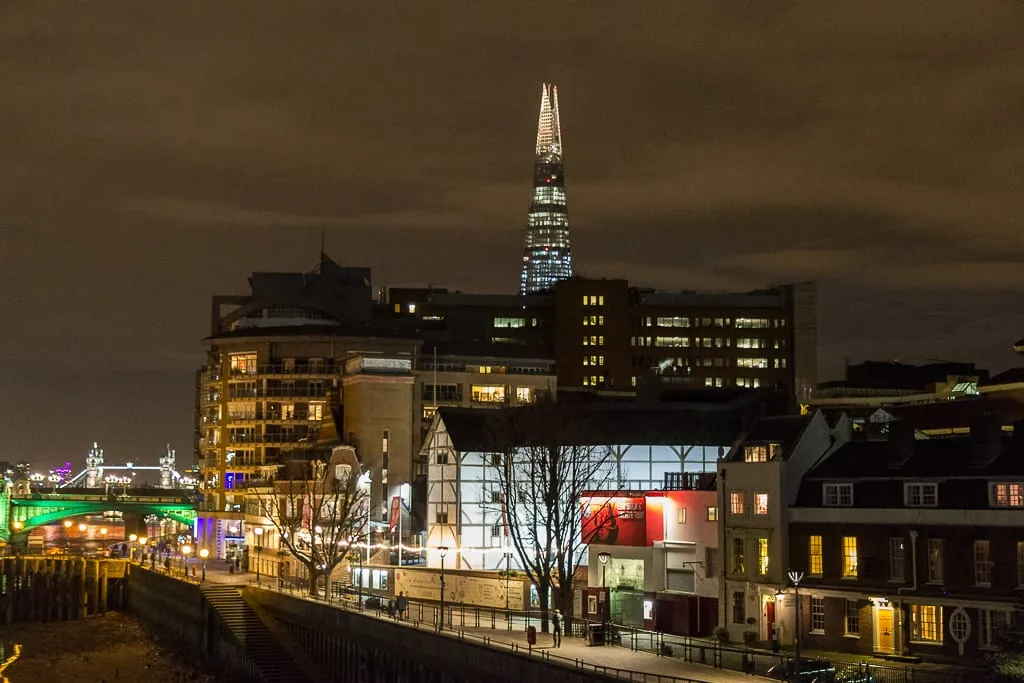
On the south bank of the Thames, facing the City, spread Southwark: a turbulent suburb, beyond the reach of London's stern magistrates. It was here, among the meadows and lanes, that English theatre was born — and here that, in 1599, the Globe opened, Shakespeare's stage.
A suburb beyond the law
Southwark escaped the authority of the City of London, which banned within its walls the amusements it judged immoral. The suburb therefore welcomed all that the city cast out: taverns, prisons, arenas for bear- and bull-baiting, brothels — and playhouses. In the 1580s and 1590s open-air wooden amphitheatres were built here: the Rose (1587), the Swan, and soon the most famous of all. It was here, before a popular and mingled crowd, that the great flowering of Elizabethan theatre was played, that of Christopher Marlowe and then of William Shakespeare.
1599: the birth of the Globe
The Globe was born of a bold stroke. In dispute with the landlord of the ground of their old playhouse (The Theatre, in Shoreditch), the players of Shakespeare's company, the Lord Chamberlain's Men, took the building apart beam by beam: on the night of 28 December 1598 the brothers Cuthbert and Richard Burbage, the carpenter Peter Street and a dozen workmen dismantled the frame, carried the timber across the Thames and rebuilt it at Southwark. So opened, in 1599, the Globe: a polygonal amphitheatre of timber and daub, thatched, open to the sky, where fifteen hundred to three thousand spectators — the humblest standing in the pit, the rest in the galleries — came to see Hamlet, Macbeth, King Lear or Julius Caesar. Its funding was shared: the two Burbages each held a quarter of the shares, and a small group of actors — Shakespeare himself among them, for an eighth — divided the rest. The playwright was thus not only the author but a part-owner of his own stage. The theatre burned in 1613 during a performance of Henry VIII (a stage cannon set the thatch alight), was rebuilt as early as 1614, then closed by the Puritans in 1642.
The theatre and its world
The Globe was no isolated building but the heart of a district of spectacle: Bankside ranged its signs along the river, and the audience crossed the Thames by wherry or over old London Bridge to spend the afternoon there. Plays were given by daylight, with no fixed scenery, on a stage that thrust out into the crowd; the nearness of the standing 'groundlings' in the pit and of the wealthy seated in the galleries made the strength of a theatre where all conditions rubbed shoulders. A faithful reconstruction, Shakespeare's Globe, opened in 1997 a few steps from the original site at the initiative of the American actor Sam Wanamaker, has given it life again.
What to see
- Shakespeare's Globe, a faithful reconstruction of the Elizabethan playhouse (1997), near the original site.
- The site of the historic Globe and of the Rose, marked on the south bank.
- The Bankside district and its relation to the Thames, the old approach of the audience.
- Southwark Cathedral, a medieval witness of the suburb.
Did you know?
The first Globe perished by theatre itself: on 29 June 1613, during a performance of Henry VIII, a cannon fired to salute the king's entrance set the thatched roof alight. In less than an hour the amphitheatre was reduced to ashes — with no casualty, it is said, save a spectator whose breeches caught fire and whom a neighbour put out with a bottle of ale. The theatre where kings were played was thus burned by a stage king.
Quiz
- On which bank of the Thames did the Elizabethan playhouses stand?
- The south bank (Southwark)
- The north bank (the City)
- On an island
- In which year did the Globe theatre open?
- 1599
- 1485
- 1666
- How was the first Globe destroyed in 1613?
- By a fire during a performance
- By a flood
- By a royal demolition