
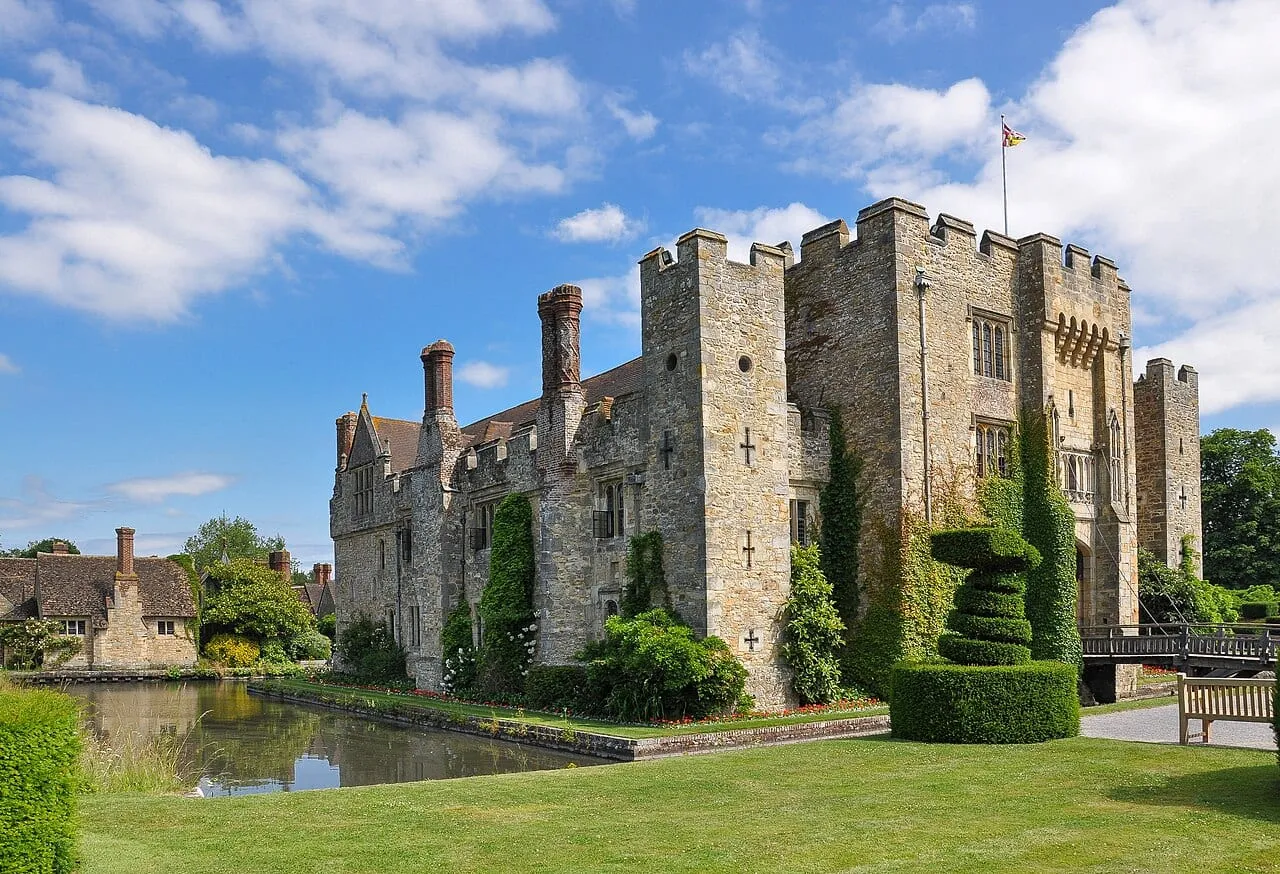
In the heart of Kent, nestled in a valley and ringed by its moat, Hever Castle has the look of a little fairy-tale castle. Yet it was, in the early sixteenth century, the childhood home of Anne Boleyn — and the setting of Henry VIII's courtship, from which came the break with Rome and the birth of modern England.
The cradle of the Boleyns
Originally a fortified medieval manor, Hever was acquired at the end of the fifteenth century by the Boleyn family, a rich line of ennobled merchants risen to court. Thomas Boleyn, a diplomat of Henry VIII, raised his children here, among them Anne, born around 1501. It was here that she spent her childhood before being sent to be schooled in the refined courts of the Low Countries and France — whence she returned adorned with an elegance and a wit that would charm a king. Hever, with its gatehouse and drawbridge, its great hall and long gallery, reflects the rise of a family whose daughter would become queen.
The courtship that changed a kingdom
Around the mid-1520s, Henry VIII, still married to Catherine of Aragon, fell madly in love with Anne Boleyn. He came to court her at Hever, wrote her passionate letters. Anne, shrewd, refused to be only a mistress: she wanted the throne. From that desire came the 'king's great matter' — the annulment of the first marriage, the divorce from Rome, the creation of the Church of England. Anne was crowned queen in 1533 and gave birth to the future Elizabeth I. Then came the fall: accused of adultery and treason, she was beheaded at the Tower in 1536. Hever, kept apart, preserves the memory of the girl before the tragedy.
From Anne of Cleves to the Astors
On the death of Thomas Boleyn in 1539, the castle reverted to the Crown. Henry VIII granted it in 1540 to Anne of Cleves, his short-lived fourth wife, as part of the amicable settlement that followed the annulment of their marriage; she remained its owner until her death. The centuries that followed saw the house decline, passing from family to family until it fell into a sorry state. Its rescue came from America: in 1903 the immensely wealthy William Waldorf Astor bought Hever and, until 1908, restored it sumptuously, adding a 'Tudor village' of lodgings for his guests, digging a great lake, and laying out a spectacular Italian garden to display his collection of antique sculpture. It is to this Edwardian renaissance that Hever owes its present setting, a learned marriage of Tudor stone and early-twentieth-century splendour.
What to see
- The moated manor and its medieval gatehouse with drawbridge.
- The Great Hall and the long Tudor gallery.
- The books of hours of Anne Boleyn, bearing, it is said, her signature.
- The Italian gardens and the lake, the work of the Astors in the early twentieth century.
Did you know?
Hever keeps two books of hours that belonged to Anne Boleyn, in one of which she is said to have written a tender message in her own hand. There is also read, tradition says, an inscription she is said to have traced beneath an illumination of the Last Judgement: a way of recalling that even a queen would have to give account. These intimate relics, turned towards a fate she did not know, give the castle its particular melancholy.
Notes
Hever Castle lies near Edenbridge, in Kent, south-east of London, amid its gardens and lake.
Quiz
- Which future queen spent her childhood at Hever Castle?
- Anne Boleyn
- Catherine of Aragon
- Jane Seymour
- What did Henry VIII's passion for Anne Boleyn set off?
- The break with Rome
- The war with France
- The building of Hampton Court
- Which intimate relic of Anne is kept at Hever?
- Her books of hours
- Her sword
- Her crown