
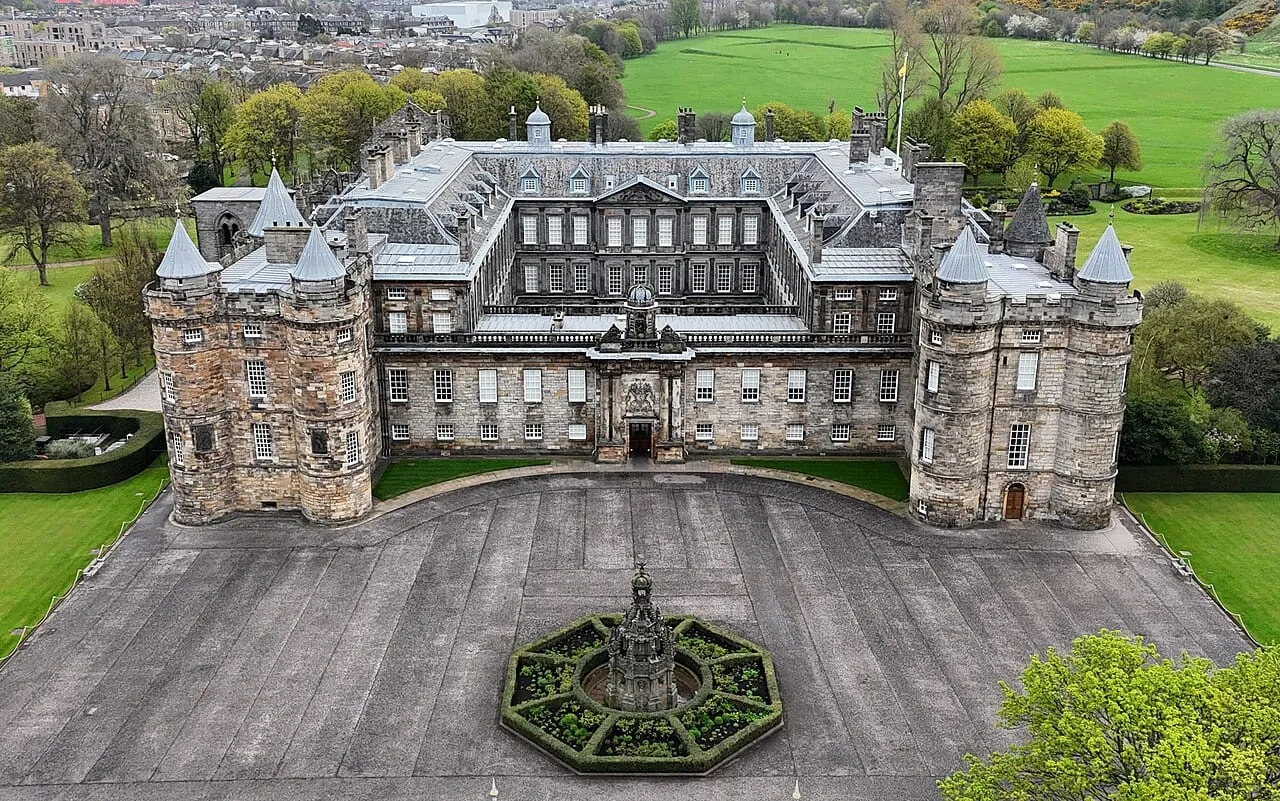
At the foot of Arthur's Seat, at the end of Edinburgh's Royal Mile, the Palace of Holyrood was the residence of the kings of Scotland and, above all, the theatre of the tragic reign of Mary Stuart. Within its walls were played the festivities, the passions and the bloody murder that precipitated the queen's fall.
The palace of the Stuarts
Born beside an abbey (Holyrood, 'the Holy Cross'), the palace was developed by the Stuart kings. James IV raised the first royal residence on the site between 1501 and 1505; his son James V enlarged it from 1528 to 1536, adding the great north-west tower with its round turrets — the oldest surviving part — and surrounding himself with French craftsmen to make of it a Renaissance palace in the fashion of those he had seen in France. The Crown's chief residence in the capital, Holyrood received the court, the ceremonies and distinguished guests. But its name remains forever attached to a single sovereign: Mary Stuart, who lived here from her return from France in 1561 until her fall.
Mary Stuart: festivities and blood
Raised at the refined court of the Valois, Mary Stuart brought back to Holyrood the French taste for balls, music and poetry — to the great scandal of the reformer John Knox, who sternly lectured her in this very palace, denouncing her dances and her Catholic Mass. It was at Holyrood that the great acts of her reign unfolded: here, in the chapel, she married her cousin Lord Darnley in 1565, and here, after the drama, she celebrated in 1567, in the great hall, her third marriage to the Earl of Bothwell. Between the two the tragedy came to a head: on 9 March 1566, in the small cabinet off her bedchamber, on the second floor of James V's tower, conspirators led by Darnley burst in and stabbed before her eyes her Italian secretary and confidant, David Rizzio, with dozens of knife blows. This murder, committed while Mary was pregnant with the future James VI, shattered her marriage and set off the spiral that would lead her to abdication in 1567, to flight into England and, twenty years later, to the scaffold. Holyrood keeps the memory of those apartments where the history of Scotland tipped into tragedy.
What to see
- The apartments of Mary Stuart, on the second floor of James V's tower, and the cabinet where Rizzio was killed.
- The north-west tower with its round turrets, built by James V (1528-1536).
- The ruins of Holyrood Abbey, beside the palace.
- The setting, at the foot of Arthur's Seat, at the end of the Royal Mile.
Did you know?
There is still shown, in Mary Stuart's apartments at Holyrood, the spot where David Rizzio was murdered in 1566; for a long time a dark stain on the floor was presented to visitors as 'Rizzio's blood' that would never fade. The legend of the indelible stain, unverifiable, says well the mark left by this murder on Scottish memory: an Italian secretary stabbed before the eyes of a pregnant queen, in her own cabinet, remained the symbol of the violence that carried off Mary Stuart.
Markers
The Palace of Holyrood (Holyroodhouse) lies in Edinburgh, at the eastern end of the Royal Mile, at the foot of Arthur's Seat; it remains the sovereign's official residence in Scotland.
Quiz
- Which queen lived at Holyrood from 1561 until her fall?
- Mary Stuart
- Elizabeth I
- Mary of Guise
- Who was murdered in the queen's cabinet in 1566?
- David Rizzio, her Italian secretary
- John Knox
- Lord Darnley
- Which reformer lectured Mary Stuart at Holyrood?
- John Knox
- Thomas Cranmer
- John Calvin