
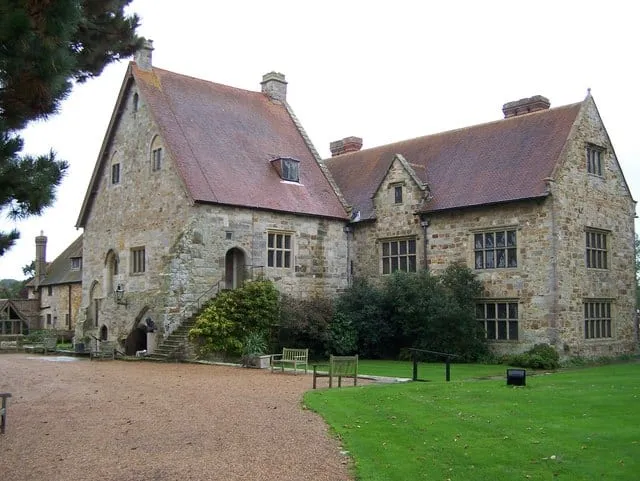
Surrounded by the longest medieval moat in England, in the East Sussex countryside, Michelham Priory offers the perfect example of a monastery transformed after the dissolution. From Augustinian house to Tudor manor, its stones tell the great religious rupture of the sixteenth century.
An Augustinian priory
Founded in 1229 by Gilbert de l'Aigle (Gilbert de Aquila), Michelham was a priory of Augustinian canons, protected by a vast moat fed by the river Cuckmere and by a fine fourteenth-century stone gatehouse. Like most small religious houses, it lived off its lands, its mills and prayer, leading for three centuries the quiet and ordered life of the canonical rule. In 1537, in the first wave of the dissolution of the monasteries ordered by Henry VIII and led by Thomas Cromwell, the priory was closed, its canons dispersed, its goods seized by the Crown. So ended, at a stroke of the royal pen, three hundred years of religious life.
From ruin to manor
Like so many former monasteries, Michelham then passed to laymen, who adapted the buildings to a new use. Over the sixteenth century the old priory was partly demolished, and what remained was turned into a Tudor house and then a farm: the canons' hall became a domestic great hall, fireplaces were cut, lodgings fitted, and the old monastic spaces partitioned into living rooms. The fine medieval gatehouse and the moat were kept, as was the mill. Michelham thus illustrates the ordinary fate of hundreds of English monasteries: not razed at a stroke, but slowly recycled into houses and farms, until their first vocation was forgotten. The attentive visitor reads, in the thickness of the walls and the plan of the rooms, this palimpsest where the manor house overlies without erasing the vanished cloister.
Water for a wall
Around 1390, Prior John Leem had the great water-filled ditch dug and the stone gatehouse raised that commands its entrance — perhaps for fear of the French raids that then threatened the Sussex coast. Ringed by its arm of water, the community stood on a true island of some seven acres, at once protected and fed: the moat served as fishpond and reserve, and its overflow drove the mill. That watermill, today restored to working order, still grinds flour, carrying on the gesture of the canons. Of all the elements of the priory, the water is the oldest and the most faithful: it has seen monks, farmers and lords pass by without ever ceasing to turn the wheel.
What to see
- The medieval stone gatehouse and the long moat (among the largest in England).
- The old canons' hall, become a Tudor great hall.
- The restored watermill and the gardens.
- The reading, in the buildings, of the passage from priory to manor.
Did you know?
Michelham is ringed by a moat nearly a mile and a half long — among the most extensive in England. Dug by the canons to protect and feed their priory, it survived the dissolution and went on serving the farm and then the house. The monks' water, meant for prayer and sustenance, thus stayed faithful to the place, long after the departure of those who had diverted it from the river.
Notes
Michelham Priory lies near Upper Dicker, in East Sussex, south of London. The site, in the care of the Sussex Archaeological Society, spreads around its gardens and mill.
Quiz
- What kind of religious occupied Michelham Priory?
- Augustinian canons
- Carthusians
- Templars
- What did the priory become after its dissolution in 1537?
- A Tudor house and then a farm
- A castle
- A cathedral
- What feature surrounds Michelham Priory?
- The longest medieval moat in England
- A crenellated rampart
- A sacred forest