
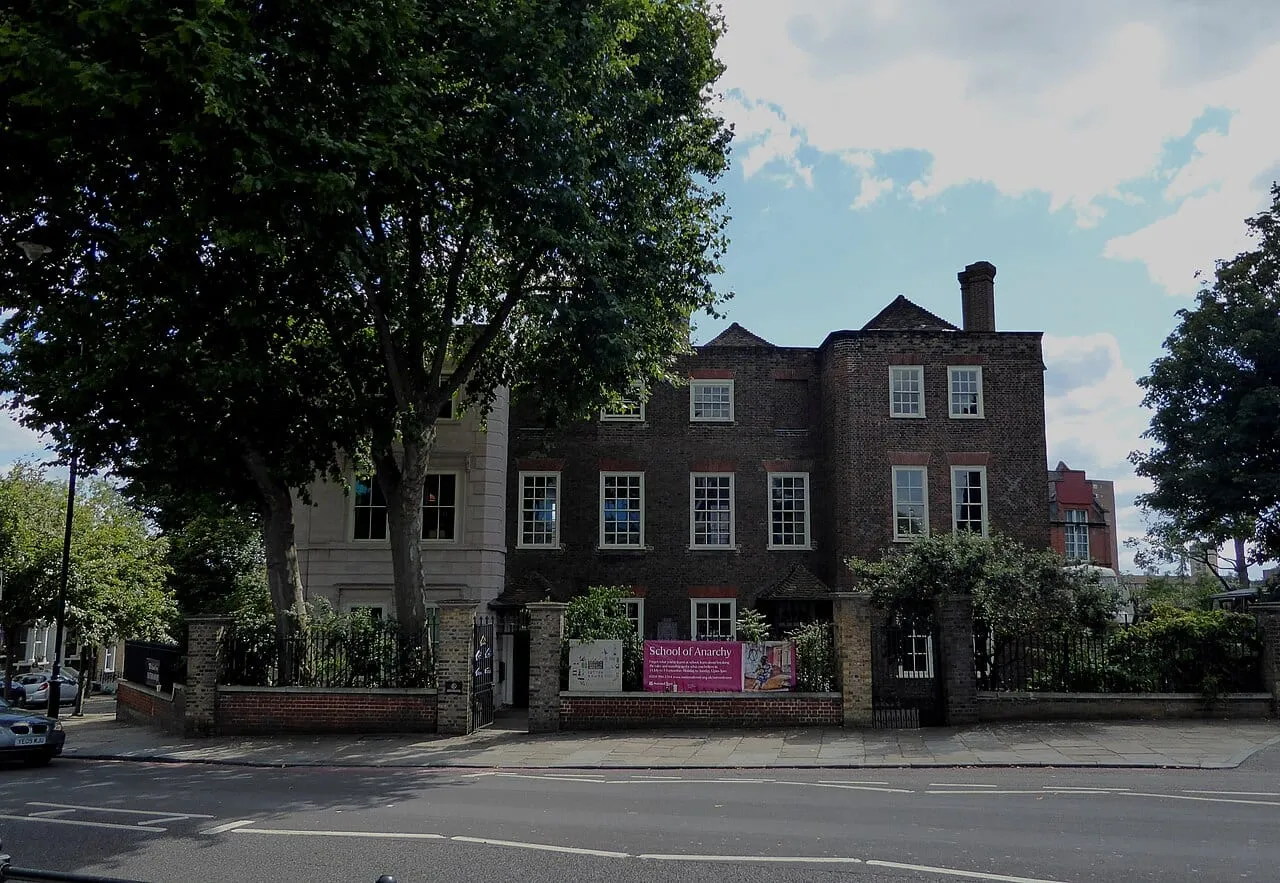
At Hackney, then a village north-east of London, Sutton House is the oldest surviving dwelling house in the capital. Built of brick in 1535, it offers a rare glimpse of the domestic life of a servant of Henry VIII's court, far from the palaces and the scaffolds.
The house of a king's man
Sutton House was built in 1535 by Ralph Sadleir (1507-1587), a young protégé of Thomas Cromwell and a rising official of Henry VIII's court, who would enjoy a long career as a diplomat and secretary of state in the Crown's service. At a time when much was still built in timber, he chose brick — a new, costly and prestigious material — and his three-storey house, then called 'the bryk place', was probably the only brick building in the village. It overlooked Hackney, in the country, where court men liked to own a residence away from the town. It illustrates to perfection the rise of a new class: the servants of the Tudor state, enriched and ennobled by their loyalty to the king.
The destiny of Ralph Sadleir
Sadleir's career reaches far beyond the walls of Hackney. Trained in the household of Thomas Cromwell, he became one of Henry VIII's two principal secretaries of state, was knighted, received his coat of arms in 1542, and served as Master of the Great Wardrobe. A knight-banneret for his conduct at the Battle of Pinkie (1547), a member of the council set up to govern in the name of the young Edward VI, he passed through the reigns without ever falling. In his late years it was to him, a trusted old servant, that Elizabeth I entrusted the keeping of a prisoner of mark, Mary Stuart: so the man who had built 'the bryk place' under Henry VIII held, half a century later, the keys of the Queen of Scots. Sutton House is the house of the youth of one of the most enduring officials of the Tudor century.
A book of domestic history
What makes Sutton House precious is that it has come down five centuries keeping the trace of all its inhabitants: oak panelling carved in linenfold, fireplaces, stairs, but also graffiti, wall paintings and successive fittings. The room known as the Linenfold Parlour keeps a panelled decoration of such rare quality that, in all London, only two other buildings — Westminster Abbey and Hampton Court Palace — hold comparable sixteenth-century linenfold. A house of merchants enriched by the cloth trade, then a girls' boarding school, a school, and even a squatters' refuge in the twentieth century, it is a rare document of everyday life across the ages. Beneath the later layers the Tudor heart remains: it is one of the few modest houses — neither palace nor castle — that the English Renaissance has left us intact, today a listed building (Grade II*).
What to see
- The oak panelling carved in linenfold, typical of the Tudor age.
- The original fireplaces and staircase.
- The wall paintings and graffiti left by successive inhabitants.
- The brick structure of 1535, rare in London.
Did you know?
Sutton House owes its name to a mistake: it was long thought to be the home of Thomas Sutton, the founder of the Charterhouse, when in fact it had been built by Ralph Sadleir. The error stuck, and the house still bears today the name of a man who never lived there — a small wink of history at the oldest house in London.
Markers
Sutton House lies at Hackney, in north-east London. It is today a house-museum in the care of the National Trust.
Quiz
- In what new and prestigious material was Sutton House built in 1535?
- Brick
- Marble
- Granite
- Who really built the house?
- Ralph Sadleir, a man of Henry VIII's court
- Thomas Sutton
- Cardinal Wolsey
- What makes Sutton House exceptional in London?
- It is the oldest surviving dwelling house
- It is the largest palace
- It is the tallest tower