
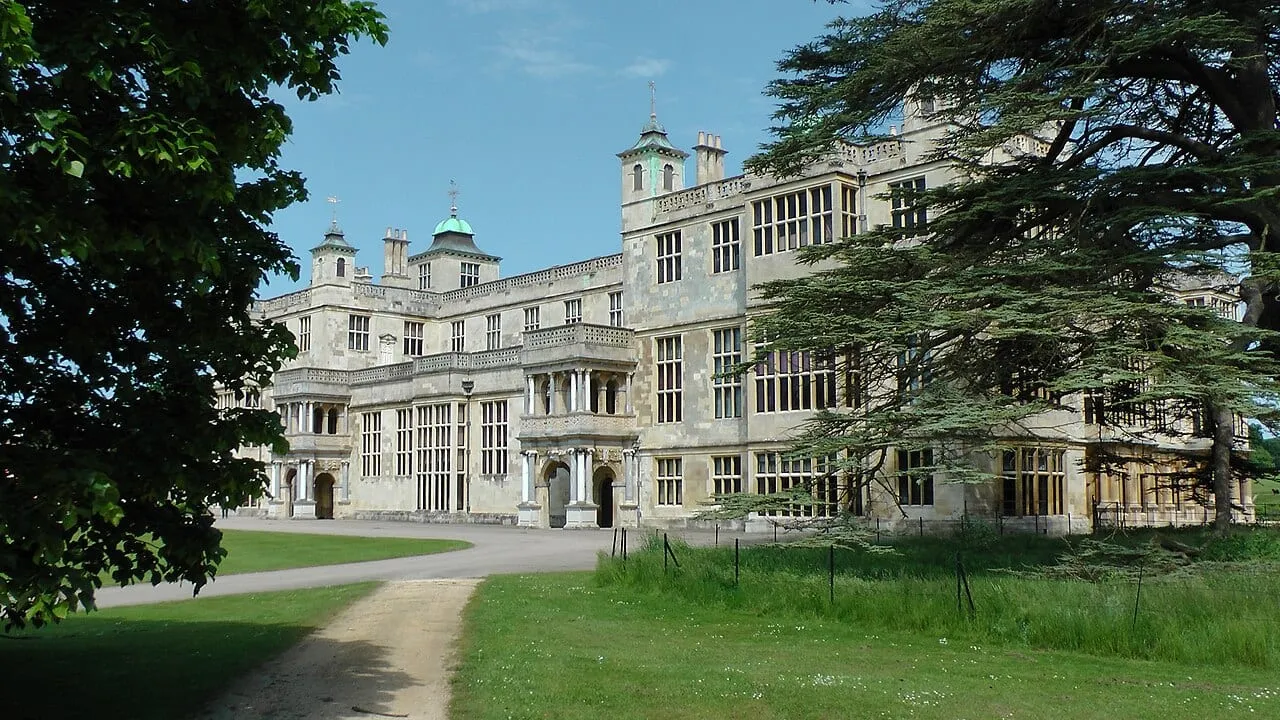
In Essex, by the river Cam, Audley End still unfurls a monumental façade — the remnant of a palace once so immense that the king himself, it is said, judged it too big. Built in the early seventeenth century on the ruins of a dissolved abbey, it is the last and most sumptuous of the great houses born of the English Renaissance.
From abbey to palace
The estate was that of the Benedictine abbey of Walden, founded in the twelfth century by the Mandeville family, dissolved by Henry VIII and given in 1538 to his chancellor Thomas Audley — hence the name of the place. Audley turned the monastic buildings into a dwelling, but it was his grandson who made Audley End a palace. Through marriage the estate passed to the Howards: Thomas Howard, first Earl of Suffolk and Lord Treasurer of James I, set out between 1605 and 1614 to raise there the largest private house in the kingdom. He drew for this on his uncle Henry Howard, Earl of Northampton, and on the Flemish mason Bernard Janssen, in the taste of the day. Completed around 1614, Audley End had hundreds of rooms, two immense successive courts, and rivalled the royal palaces. It was the culmination of the tradition of the prodigy houses: to build ever larger to dazzle and, one day, to receive the king.
Excess and decline
Legend relates that James I, on a visit, let slip that the house was 'too big for a king, though it might do for a lord treasurer' — an acid remark on the means (and perhaps the embezzlement) of his minister. Indeed Thomas Howard fell soon after into disgrace, accused of misappropriation, and was for a time imprisoned in the Tower. The house, ruinous to maintain, was reduced by more than half over the generations: in the early eighteenth century the architect John Vanbrugh advised and oversaw the demolition of the great outer court, and other wings came down after. What survives, already imposing, is only a part of the original palace. Audley End thus closes, on a note of pride and fall, the great century of English houses — just before the classicism of Inigo Jones changed the rules of the game.
A palace that passed to the king
In 1668 King Charles II acquired Audley End for some fifty thousand pounds, to make it a royal residence close to the Newmarket horse races he loved. The house of a minister thus became, for a time, a king's palace. But the Crown, a poor payer, never fully settled the purchase: by the end of the century the house reverted to the Suffolks, who held it before it changed hands again. That brief royal ownership remains the late irony of a building James I had found 'too big for a king'.
The taste of the centuries
In the eighteenth century Audley End had a second, aesthetic life. The architect Robert Adam designed refined neoclassical interiors there, while the landscape gardener Capability Brown, around 1762, remodelled the surroundings: he turned the river Cam into a shimmering sheet of water, laid out lawns and groves, and scattered the park with follies — among them an elegant Palladian bridge attributed to Adam. The Jacobean house was thus set within a composed landscape, layering two ages of English taste: the decorative profusion of the Howards and the calculated serenity of the eighteenth century.
What to see
- The monumental Jacobean façade, remnant of the original palace.
- The great Hall with its carved screen and roof.
- The apartments and the neoclassical decoration of Robert Adam.
- The landscaped park redesigned by Capability Brown, with its bridge and river.
Seeing it differently
Look along the façade for the quiet asymmetry that betrays the demolitions: what seems a complete composition is only the central block of an ensemble once three times as vast. Before the house, imagine the vanished outer court, its porticoes and galleries swallowed up. Inside, the great hall keeps its double screen of carved wood and stone, a theatrical frontier between servants and masters. The whole house tells one lesson: the building pride of a man, then the centuries that patiently pare down his dream of stone until they give it its true measure.
Did you know?
Audley End was so sumptuous that the Crown ended by buying it: at the end of the seventeenth century, King Charles II acquired it to make it a royal residence, close to the Newmarket races. The house of a minister thus became, for a time, a king's palace — a late irony after James I's quip, who had found it 'too big for a king'. A subject's excess had ended by catching up with the Crown itself.
Notes
Audley End lies near Saffron Walden, in Essex, north of London, and is today in the care of English Heritage.
Quiz
- On the lands of what kind of establishment was Audley End built?
- A dissolved abbey (Walden)
- A Norman castle
- A theatre
- Which minister of James I had Audley End built?
- Thomas Howard, Earl of Suffolk
- William Cecil
- Francis Bacon
- What does legend say of James I's remark about the house?
- That it was 'too big for a king'
- That it was too modest
- That it looked like Hampton Court