
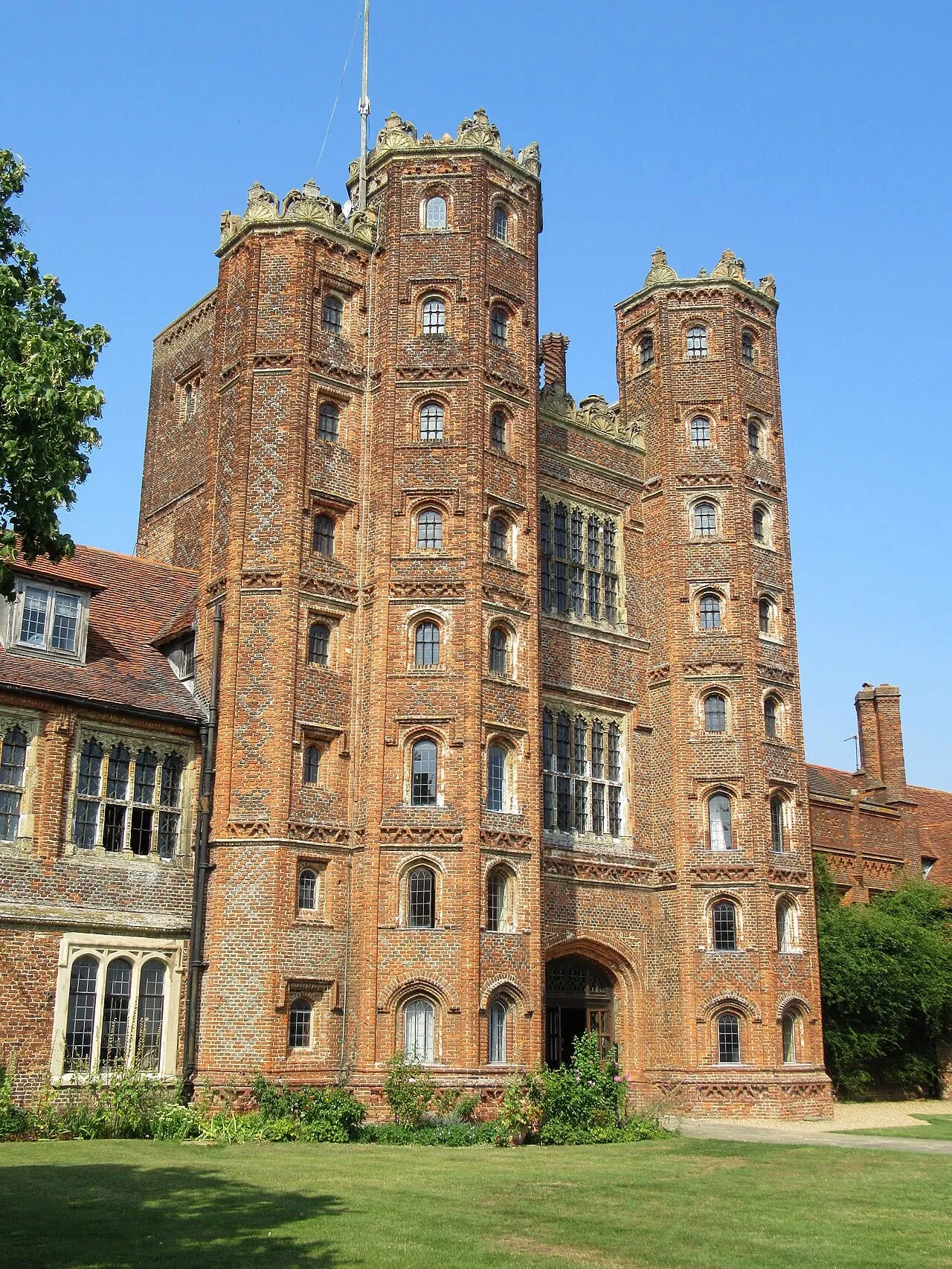
In the Essex countryside stands an extraordinary brick tower of eight storeys, crowned with Italian-style terracottas: Layer Marney Tower, the tallest Tudor gatehouse in England. It is the dream of grandeur of a courtier of Henry VIII — a dream that death left unfinished.
The ambition of a king's man
In the early 1520s, Henry, 1st Lord Marney, a high dignitary of Henry VIII's court (Keeper of the Privy Seal), set out to transform his family manor into a prodigious house. He began with the centrepiece: a monumental gatehouse, a symbol of status, meant to announce the wealth and rank of the master. Built of brick — the prestigious material of the age — it rises more than twenty-four metres (some eighty feet), adorned with windows and crownings in Renaissance-style terracotta, the work of craftsmen very likely brought from Italy: it is one of the first examples of this antique decoration in England, where the Gothic battlements give way to curves and shells of classical inspiration.
An interrupted work
Fate did not follow the ambition. Lord Marney died in 1523, his son John, 2nd Lord Marney, survived him barely two years, and the male line died out. The great house was never completed: only the gatehouse, a few buildings and the neighbouring church of St Mary bear witness to what the palace should have been. In that church the Marneys lie beneath fine tombs, where the same Italianate terracotta clothes the funerary stone — the tomb of Henry Marney is reckoned the most accomplished of all. Layer Marney thus remains a splendid fragment, a 'what if' of Tudor architecture — the monumental gate of a house that never existed. It is no less a crucial landmark: through its terracottas, it marks the arrival of the Renaissance vocabulary in the English landscape.
Reading the stone
The tower rewards a close look. Lord Marney, a friend of Henry VII as of Henry VIII, called on craftsmen familiar with the novelties coming from the continent: moulded terracotta draws the mullions, transoms and crownings of the great windows, while the battlements abandon the bristling line of the Gothic for a run of curves and shells of Italian inspiration. The red brick, fired in great quantity for the purpose, proclaims the master's wealth all on its own: in the early sixteenth century, to build in brick was to rise to the rank of the royal palaces of Hampton Court or Sutton Place. Nothing in this front is defensive: all is display and magnificence, and the visitor who climbs the eight storeys measures, floor by floor, the scale of an ambition left without sequel.
What to see
- The eight-storey brick gatehouse tower, the tallest in England.
- The Renaissance terracottas (windows, crownings) with their Italian curves.
- The neighbouring church of St Mary and the Marney tombs.
- The view from the top of the tower over the Essex countryside.
Did you know?
Layer Marney is a gate without a castle: the gatehouse was built first, as was the custom, to impress the visitor at once — but the house it was to announce never came into being, the family having died out. There remains, then, planted in the countryside, a monumental threshold opening onto… almost nothing. Rarely are the ambition and the fragility of a Tudor courtier read so clearly in stone.
Notes
Layer Marney Tower lies near Colchester, in Essex, north-east of London, amid its gardens; one can climb to the top of the tower.
Quiz
- What is Layer Marney Tower?
- The tallest Tudor gatehouse in England
- A Norman keep
- A lighthouse
- Why did the great house remain unfinished?
- The Marney family died out soon after
- A fire destroyed the works
- The king forbade it
- Which Renaissance decoration adorns the tower?
- Italian-style terracottas
- Gothic stained glass
- Byzantine mosaics