
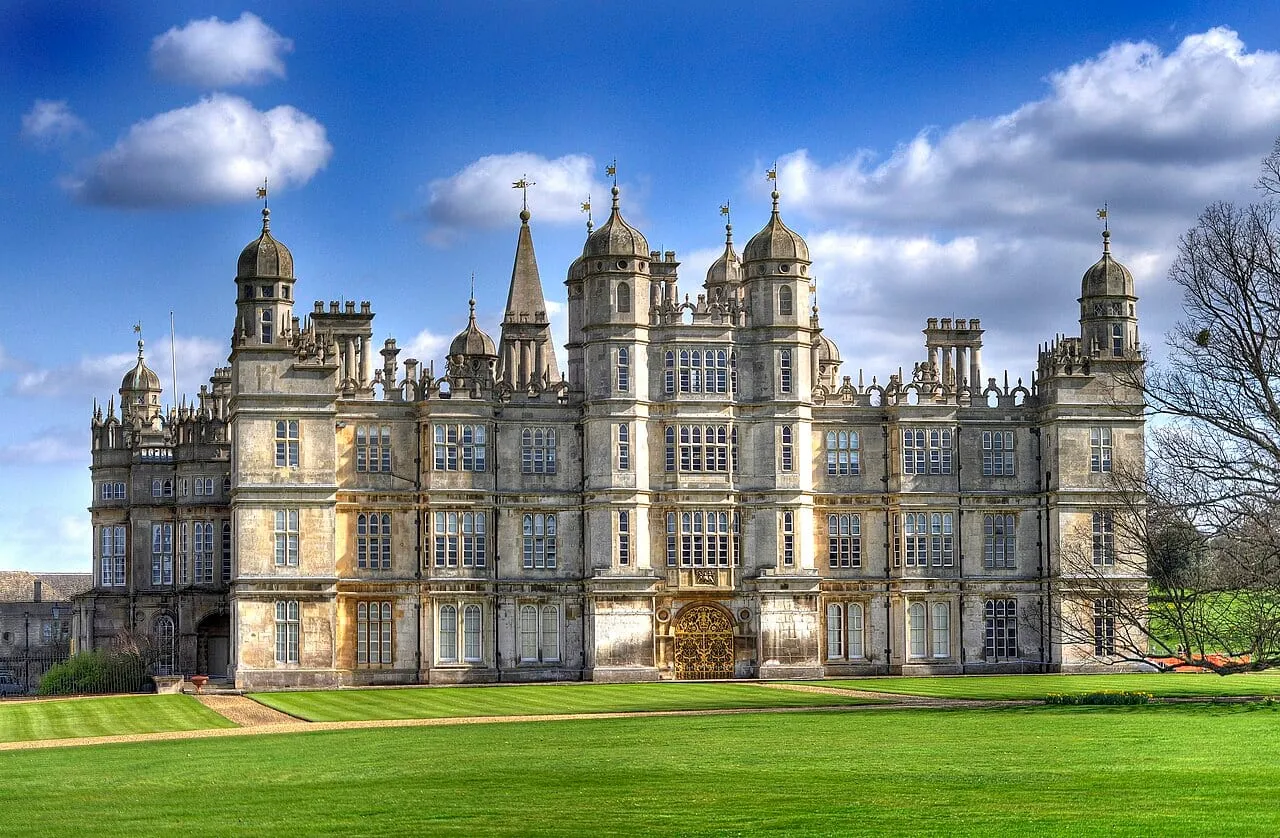
Near Stamford, bristling with turrets, chimneys and cupolas, Burghley House is one of the largest and most sumptuous houses of Elizabethan England. It was built by William Cecil, Lord Burghley, the minister who, for forty years, governed England alongside Elizabeth I.
The house of a statesman
William Cecil was the most faithful and most powerful servant of Elizabeth I: Secretary of State and then Lord Treasurer, he was, for four decades, the architect of the kingdom's policy. Like all the great Tudor ministers, he wanted a house to match his power. Between 1555 and 1587 he built and rebuilt Burghley without cease, sinking a fortune into it, drawing up part of the plans himself and following the works down to the smallest detail from London through a tireless correspondence. The house is a prodigy house — one of those immense residences the great courtiers built to assert their rank and, above all, to be able to receive the queen on her great journeys (the progresses). Cecil in fact owned a second prodigy house, Theobalds, in Hertfordshire, which Elizabeth visited many times, and which cost its builder vast sums.
A manifesto in stone
Burghley mingles with splendour the influences of the age: a symmetrical silhouette, an immense façade of golden limestone patterned with great windows, but a fantastic crowning of turrets, chimneys disguised as classical columns, cupolas and obelisks, that make the roofline a veritable city of stone. The clock and the weathervanes, the pierced pinnacles, the restless play of volumes: nothing is left to chance in this calculated profusion. Inside, the timber-roofed Hall, the monumental chimneypieces and the long galleries display the Elizabethan taste for magnificence. Cecil, a sober and hard-working man, gave himself here a prince's setting — for in the England of Elizabeth, stone was a political language: to build big was to proclaim one's loyalty and one's credit with the Crown.
The house of the Cecils, from Tudor stone to Brown's park
On Lord Burghley's death the house passed to his eldest son Thomas Cecil, created Earl of Exeter, and it has never left the family: the Cecils, Marquesses of Exeter, live there still. The centuries that followed respected the Elizabethan shell while enriching it: in the eighteenth century the landscape gardener Capability Brown redrew the park, dug a lake and clothed the surroundings with lawns and groves, framing the old Tudor house in a 'natural' setting in the taste of the day. This dialogue between the rigour of the Tudor stone and the softness of the English park makes all the charm of the place today.
What to see
- The roofline, a forest of turrets, chimneys, cupolas and obelisks.
- The symmetrical Elizabethan façade of golden limestone, immense and patterned.
- The great timber-roofed Hall and the monumental chimneypieces.
- The landscaped park and its lake, redrawn by Capability Brown.
Did you know?
Great houses like Burghley bear the name of 'prodigy houses' — because their builders designed them above all for a single guest: the queen. Elizabeth I travelled each summer through her kingdom, lodging with her great subjects; to receive the sovereign and her train (hundreds of people) sometimes ruined the host, but secured his favour. Cecil thus built Burghley in part for that supreme honour — the most costly of all.
Notes
Burghley House lies near Stamford, on the edge of Cambridgeshire and Lincolnshire. It is a house still linked to the Cecil family, at the heart of its park and gardens.
Quiz
- Which minister of Elizabeth I had Burghley House built?
- William Cecil, Lord Burghley
- Thomas Cromwell
- Francis Walsingham
- What are these immense houses built to receive the queen called?
- 'Prodigy houses'
- 'Wool churches'
- 'Follies'
- What makes Burghley's roofline spectacular?
- A forest of turrets, chimneys and cupolas
- An immense glass wall
- A single gilded dome