
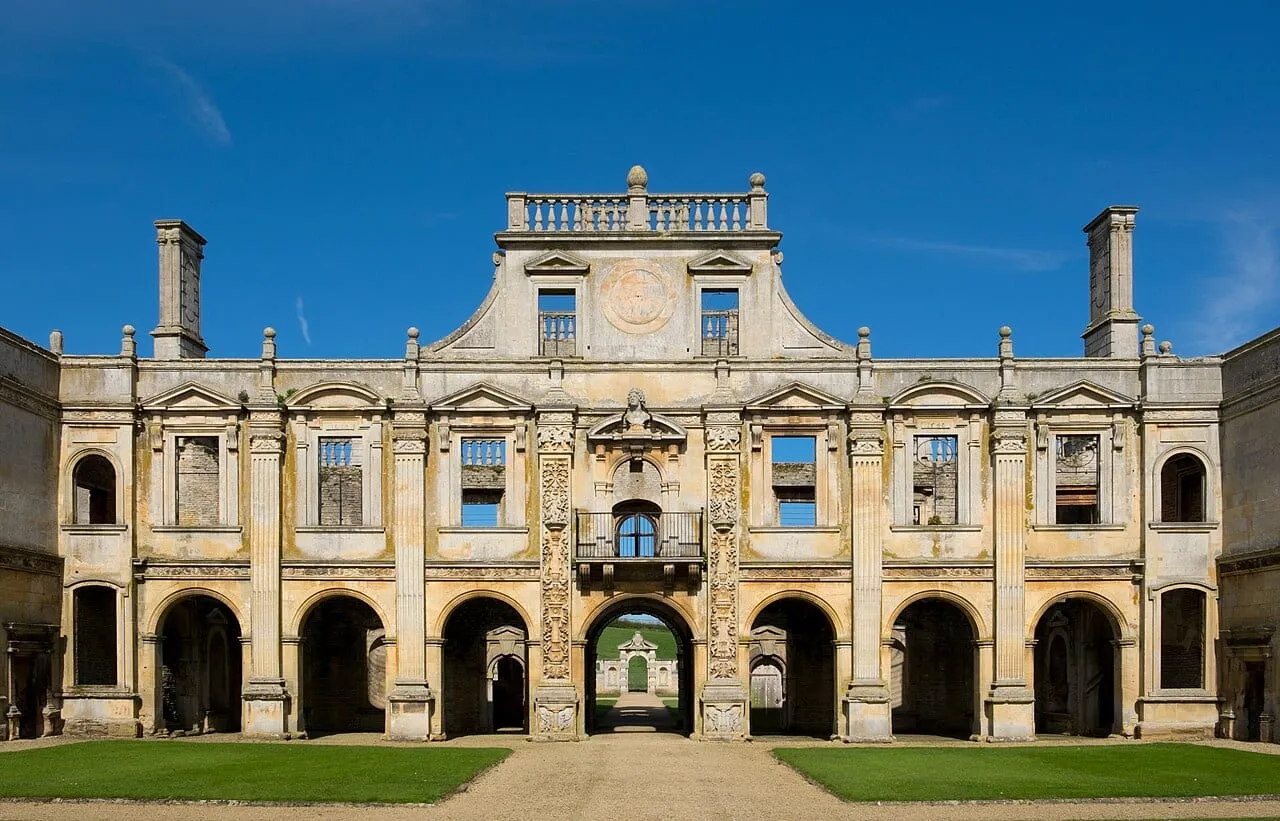
Amid the fields of Northamptonshire, Kirby Hall raises its façades adorned with pilasters, half-ruined, open to the sky. It was one of the most elegant prodigy houses of the Elizabethan age — built, ironically, by a favourite of Elizabeth I who, kept at court, hardly ever lived there.
The house of an absent favourite
Begun in 1570 for Sir Humphrey Stafford of Blatherwick (to designs by a mason of the Thorpe family), Kirby Hall was bought in 1576, after the death of its first builder, by Sir Christopher Hatton — a virtuoso dancer who became, legend says, the queen's favourite for the elegance of his steps, and then Lord Chancellor of England. Like all the great courtiers, Hatton wanted a house worthy of receiving the sovereign on her journeys. He made Kirby a jewel of architecture, turning the house to look outward, adorning its courts with giant pilasters and a learned decoration inspired by the Italian and French treatises — among the most refined of the age in England. But the queen's service kept him in London: Hatton, ruined by his court and building expenses, hardly ever enjoyed the house he had built for her.
From classical grandeur to abandonment
Kirby knew its height in the seventeenth century, under Hatton's descendants: Sir Christopher Hatton III then had the house remodelled in a new classical style, sometimes attributed to the circle of Inigo Jones, which brought to its façades an antique vocabulary still rare on English country houses. Fine 'cutwork' gardens were laid out, counted among the most admired in the kingdom. Then came the slow decline: abandoned and then stripped of its roofs over the centuries, the house froze into an elegant ruin. Its carved façades still stand, intact in their design, but open to the wind. This partial ruin makes all the melancholy charm of the place — a manifesto of architecture reduced to its skeleton of stone, in which the pure ambition of the Renaissance builders can be read better than in a furnished house. Today, free-roaming peacocks pace the courts and the restored gardens, having become the living emblem of the place. People come for this paradoxical beauty: a house too perfect to be lived in, given over to the grasses, the sky and the cries of the great birds — a fragment of Renaissance ambition left in the open air, more eloquent in ruin than many a house still roofed.
What to see
- The giant-pilaster façades of the court, a masterpiece of Elizabethan decoration.
- The Great Hall and the carved entrance porch.
- The restored 'cutwork' gardens, where the peacocks wander.
- The atmosphere of elegant ruin, open to the sky.
Did you know?
Sir Christopher Hatton owed his fortune, it is said, to his grace as a dancer: Elizabeth I is said to have noticed him for his elegance at a ball, and his meteoric rise earned him the mocking nickname of the 'dancing chancellor'. But the dance led to ruin: the expenses of court and the building of Kirby (and another house) put him so deep in debt that he died, it is said, heartbroken at owing money to his queen. The finest of houses was thus born of a dance step and ended in debt.
Notes
Kirby Hall lies near Corby, in Northamptonshire, in the centre of England. It is today a site in the care of English Heritage, whose courts, façades and gardens can be walked through.
Quiz
- Which favourite of Elizabeth I completed Kirby Hall?
- Sir Christopher Hatton
- Robert Dudley
- William Cecil
- What adorns the façades of Kirby's court?
- Giant pilasters
- Mosaics
- Stained glass
- In what state is Kirby Hall today?
- Half-ruined, open to the sky
- Fully furnished and lived in
- Turned into a cathedral