
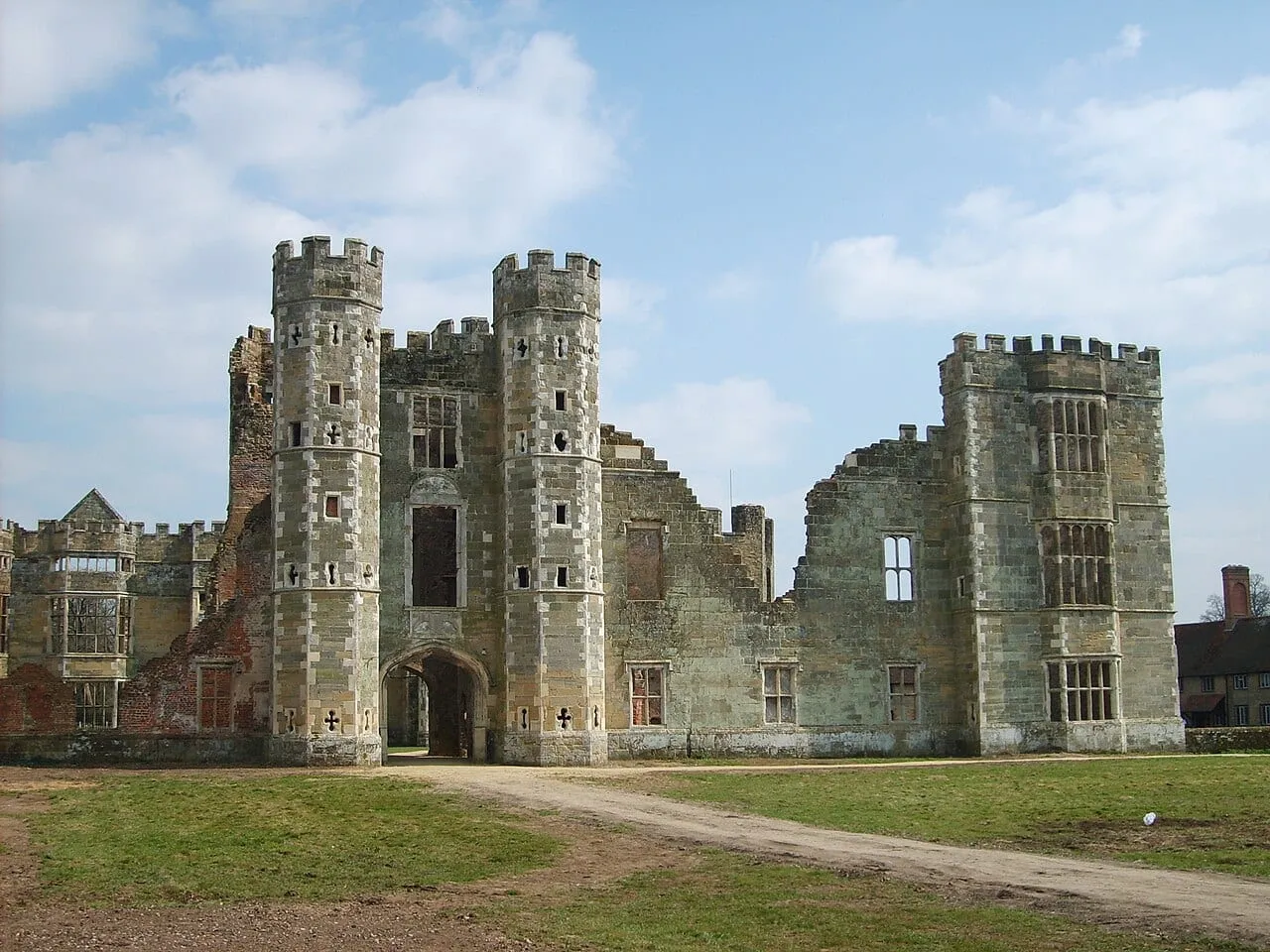
At Midhurst, in West Sussex, the golden ruins of Cowdray House evoke the lost splendour of one of the greatest Tudor houses in southern England. Frequented by kings, held by a powerful Catholic family, it was the setting of royal splendours before a fire reduced it, in one night, to a skeleton of stone.
A house at the height of royal favour
Built from around 1520 (first by Sir David Owen), Cowdray passed in 1529 to Sir William Fitzwilliam, future Earl of Southampton, then to the Brownes, Viscounts Montague, an influential Catholic family who managed to stay in the sovereigns' favour despite their faith. Sir Anthony Browne received the estate, and his son was created 1st Viscount Montague by the Catholic queen Mary I in 1554. The house knew its apogee under the Tudors: Henry VIII stayed here several times (1538, 1539, 1545), and Elizabeth I was received here in 1591 with lavish entertainments — banquets, hunts and allegorical spectacles worthy of a queen. It was also at Cowdray that, on 6 October 1573, Henry Wriothesley, 3rd Earl of Southampton, Shakespeare's patron and probable 'fair youth' of the Sonnets, was born.
Architecture and grandeur
Cowdray displayed all the marks of the great Tudor house: a monumental three-storey gatehouse, a vast great hall, kitchens, a chapel and long galleries set around closed courts. Built of pale stone that time has gilded, it was in the sixteenth century one of the most admired houses in the kingdom, and remained so until the late eighteenth century. The Brownes kept state here as convinced Catholics — so much so that the 2nd Viscount for a time employed in his household a young Yorkshireman named Guy Fawkes, the future figure of the Gunpowder Plot.
The curse of fire and water
On 24 September 1793, a catastrophic fire ravaged Cowdray: begun, it is said, in a carpenters' workshop where embers fell on the sawdust, it reduced the house to a ruin. The disaster was followed, in the same year, by the drowning of the young 8th Viscount Montague, swept away over the falls of the Rhine at Laufenburg. The coincidence revived an old legend: at the dissolution of the monasteries, a monk dispossessed of Battle Abbey, granted to the Brownes, is said to have cursed the family 'by fire and by water'. Two centuries later, fire and water seemed to fulfil the prophecy. Restored and reopened to the public in 2007, the ruins today offer a moving testimony of Tudor magnificence.
What to see
- The ruins of the great Tudor house (Grade I listed), gilded by time.
- The three-storey gatehouse and the walls of the great hall.
- The remains of the courts, kitchens and galleries.
- The memory of Henry VIII, Elizabeth and the young Earl of Southampton.
Did you know?
The man to whom Shakespeare dedicated his first poems was born within these walls: Henry Wriothesley, 3rd Earl of Southampton, came into the world at Cowdray on 6 October 1573. Patron of the young playwright, he is the dedicatee of Venus and AdonisandThe Rape of Lucrece, and many see in him the mysterious 'fair youth' to whom many of the Sonnets are addressed.
Notes
Cowdray House (ruins) lies at Midhurst, in West Sussex; the site is in the care of the Cowdray Heritage Trust, and is reached beside the river Rother.
Quiz
- Which sovereigns frequented Cowdray?
- Henry VIII and Elizabeth I
- Only Norman kings
- None
- Which patron of Shakespeare was born here in 1573?
- Henry Wriothesley, Earl of Southampton
- Francis Bacon
- Robert Dudley
- What happened to Cowdray in 1793?
- A fire reduced it to a ruin
- It was enlarged
- It became a royal palace