
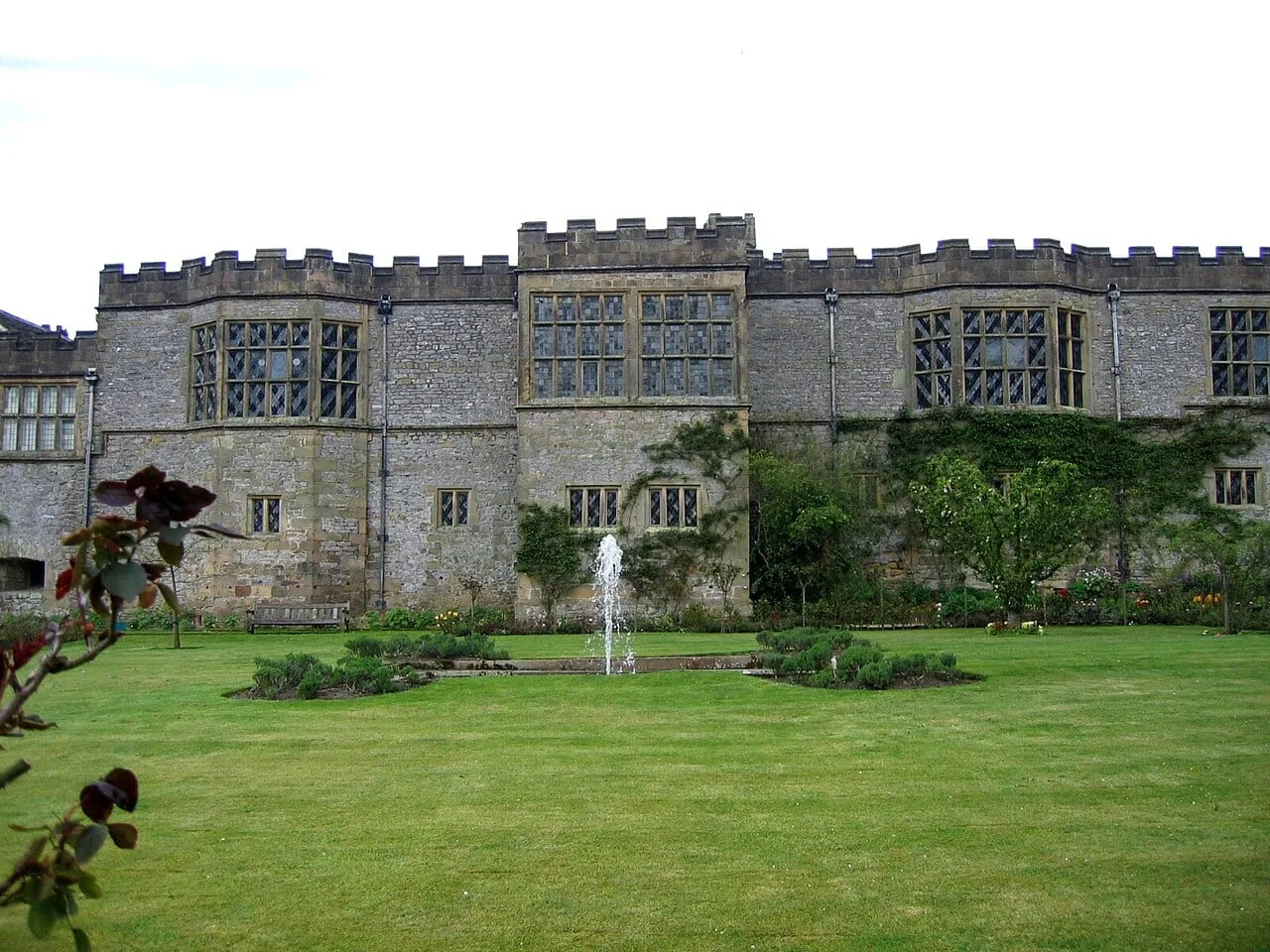
On the banks of the Wye, in Derbyshire, Haddon Hall is reckoned one of the best-preserved medieval and Tudor manor houses in England — because for nearly two centuries it was neglected, and so left unaltered. Its great Elizabethan gallery, its terraces and its love legend make it an intact jewel of the English Renaissance.
From the Vernons to the Manners
Haddon's origins go back to the 11th century: at the time of the Domesday Book the manor was held by William Peverel, and by 1194 licence had been obtained to raise its walls. Sir Richard de Vernon came into possession around 1170 through his marriage to Alice Avenell: the Vernons would build most of the manor over the centuries. The dates of its great medieval campaigns can still be read — the banqueting hall, kitchens and parlour dated 1370, St Nicholas's Chapel completed in 1427 and adorned with early wall paintings.
Under the Tudors, Haddon passed from the Vernons to the Manners by marriage. Sir George Vernon (c. 1503-1565), nicknamed the "King of the Peak" for his princely style of living, had only two daughters, Margaret and Dorothy. In 1563, Dorothy Vernon married John Manners, younger son of Thomas Manners, 1st Earl of Rutland. Through this union the manor entered the Manners family (later Dukes of Rutland), who hold it still. To John Manners belongs the finest Renaissance work in the house: the Long Gallery, completed around 1600, its panelling articulated by classical pilasters and arches, its frieze running from one emblem to another — the Vernon boar's head, the Manners peacock — and its windows glazed in diamond panes.
A house frozen in time
Haddon's singularity is to have crossed the centuries almost unchanged. When the Manners made Belvoir Castle their principal seat, Haddon was neglected and ceased to be modernised — preserved by the very indifference of its owners. So one finds there, intact, a medieval Great Hall with its minstrels' gallery, the chapel with its wall paintings, and terraced gardens that tumble down the slope towards the river. In the 20th century the 9th Duke of Rutland set about restoring the whole from the 1920s with the architect Harold Brakspear; the house was Grade I listed in 1951. This rare authenticity makes Haddon a prized film location and a distillation of English seigneurial living. Look for: the Long Gallery with its Vernon and Manners emblems, the Great Hall and its minstrels' gallery, St Nicholas's Chapel, the stepped terraces and gardens.
Did you know?
Legend has it that Dorothy Vernon fled Haddon one evening during a ball to join her lover John Manners: crossing the gardens, running down a stone stair and over a footbridge in the night, she is said to have slipped her family's watch to marry him in secret. The story is in fact a 19th-century invention; the marriage itself certainly took place, in 1563, and the couple, reconciled with Sir George, inherited the estate on his death two years later. The "Dorothy Vernon" steps and bridge can still be visited.
Renaissance notes
Haddon Hall lies near Bakewell in Derbyshire, on the Wye. Its Renaissance interest rests on its Elizabethan Long Gallery and its exceptional state of preservation, owed to its long neglect in favour of Belvoir Castle.
Quiz
- How did Haddon pass to the Manners?
- Through Dorothy Vernon's marriage to John Manners (1563)
- By conquest
- By a royal purchase
- Why is Haddon so well preserved?
- Neglected for Belvoir, it was never modernised
- It was rebuilt in the 19th century
- It was never inhabited
- What does the Dorothy Vernon legend tell?
- Her night-time flight to marry John Manners (a 19th-century tale)
- A battle
- A hidden treasure