
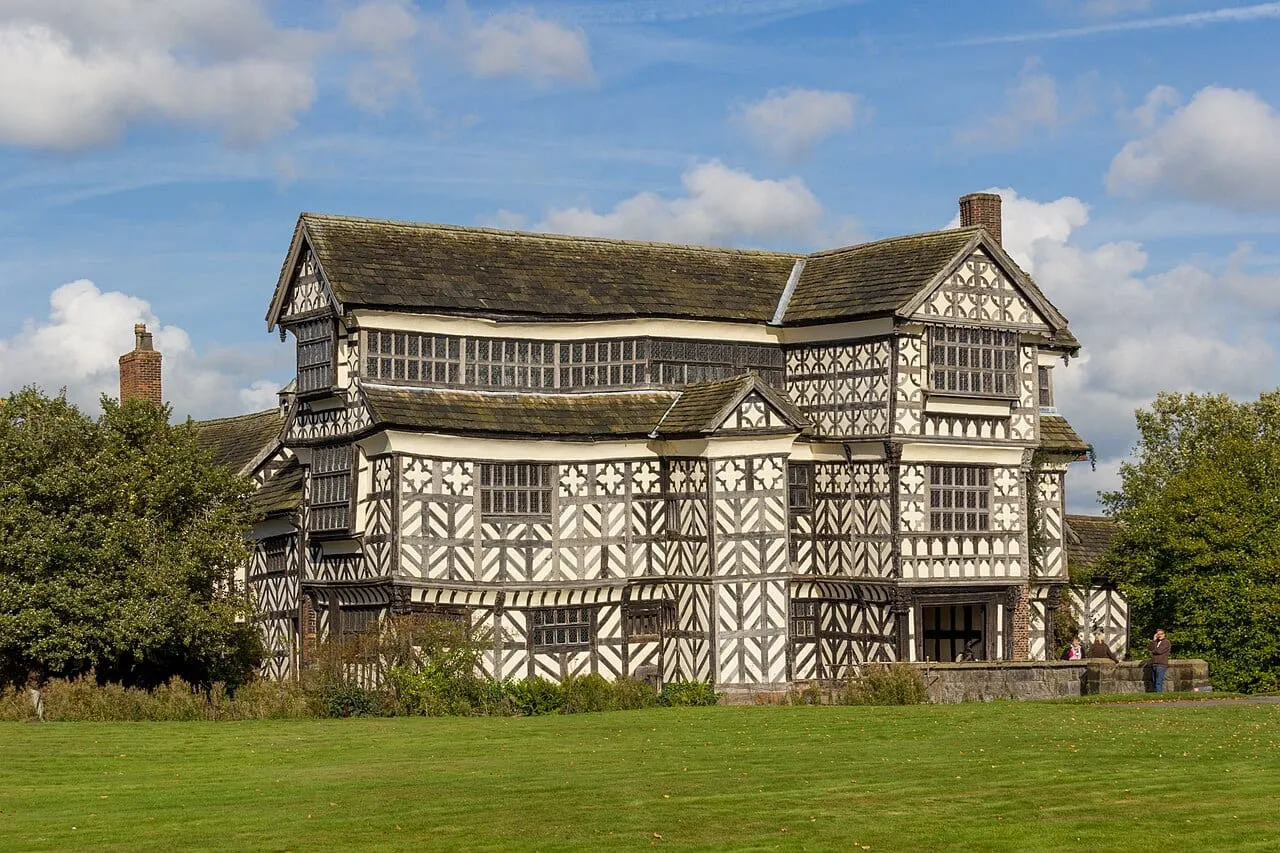
In Cheshire, near Congleton, Little Moreton Hall is perhaps the most spectacular timber-framed house in England: an extraordinary structure of black wood and white plaster, ringed by a moat, with leaning walls and rippling glazed windows. Built over more than a century by the Moreton family, it is a living manifesto of the English domestic Renaissance.
A house built over a century
Little Moreton Hall was not raised all at once but in stages, from 1504 to 1610, each phase reflecting the Moreton family's growing wealth and changing taste. The north range, with its great hall, was built around 1504-1508 for William Moreton I (died 1526); the east range was extended around 1508 to house a chapel and a withdrawing room. Around 1546, William Moreton II (c. 1510-1563) — who already held some 1,360 acres by the start of Elizabeth's reign — rebuilt the west wing. In 1559, a floor was inserted into the great hall, then fitted with two great bay windows onto the courtyard. Finally, around 1560-1562, John Moreton (1541-1598) added the south wing, with its gatehouse and its 68-foot (about 21 m) Long Gallery; the last extension — kitchen and brewhouse — dates to 1610.
This growth by successive additions, around a courtyard and a moat 33 feet wide (a relic of the 13th-14th centuries, far more a status symbol than a defence), gives the house its improbable silhouette — leaning walls, overhanging storeys, timbers that seem to defy gravity. Far from a flaw, this apparent instability is the building's very charm.
A feast of wood and glass
Little Moreton Hall is a celebration of Tudor carpentry. Its great hall opens beneath arch-braced roof trusses carved with motifs including dragons. Its Long Gallery, at the very top of the house, ripples under the weight of the centuries; its gables carry two plaster tympana representing "Destiny" and "Fortune," copied from a learned work, Robert Recorde's Castle of Knowledge (1556). Its windows hold some 30,000 small leaded panes, a dazzling luxury at a time when glass was rare and costly; its chapel preserves late-16th-century tempera paintings on biblical themes. An inscription carved in 1559 even signs the work in the name of the carpenter Richard Dale — rarely does a craftsman lay claim to his creation like this. Look for: the "long and crooked" Long Gallery and its plaster figures, the arch-braced Great Hall, the chapel and its paintings, the patterned bay windows.
Did you know?
On one window at Little Moreton Hall, an inscription of 1559 proudly signs the work: "God is Al in Al Thing: this windous whire made by William Moreton in the yeare of Oure Lorde MDLIX. Rycharde Dale, Carpeder, made thies windous by the grac of God." It is rare, in the Renaissance, for a mere craftsman to carve his name beside the master's: the carpenter Dale meant posterity to know who had built these prodigious windows.
Renaissance notes
Little Moreton Hall lies near Congleton in Cheshire. During the Civil War, in 1643, the house was requisitioned by Parliamentarians to billet soldiers; the family, ruined, stopped living there in the late 1670s, and the house was then let to tenant farmers, which spared it any modernisation. It belongs today to the National Trust.
Quiz
- What is exceptional about Little Moreton Hall?
- It is a masterpiece of moated Tudor timber-framing
- It is an artillery fort
- It is a cathedral
- Over how long was it built?
- Over more than a century (1504-1610)
- In one year
- In one day
- Who signed the windows in 1559?
- The carpenter Richard Dale
- Queen Elizabeth
- Shakespeare