
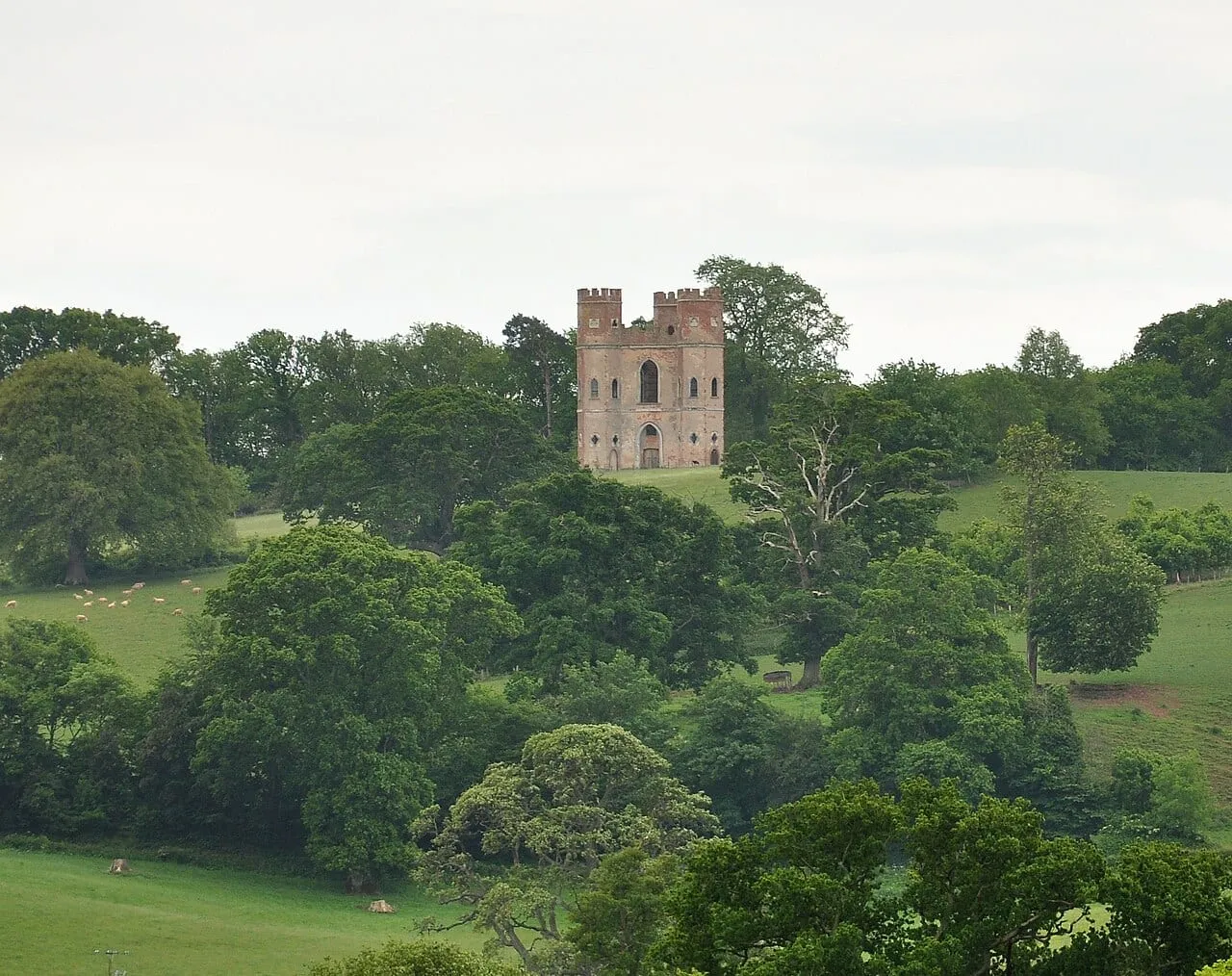
By the estuary of the Exe, in Devon, Powderham is the seat of the junior branch of the Courtenays, one of the oldest noble families in England. If the visible fabric is today largely remodelled, the Renaissance history of the place is that of a dynasty: its patience, its services to the Crown, and its reconquest of a lost title.
The Powderham branch of the Courtenays
The medieval core of Powderham was raised after 1390 by Sir Philip Courtenay (c. 1355-1406), founder of the line known as 'Courtenay of Powderham'; it took him nearly thirty years to complete this fortress on the banks of the Exe, of which the left-hand tower and the great hall of the central block date from that time. At the dawn of the Tudor age, the house was the seat of the Powderham branch of the Courtenays — juniors of a great house whose senior line resided at Tiverton. Throughout the period, these Courtenays of Powderham were an active and rising gentry of Devon: justices of the peace, sheriffs, members of Parliament, they embodied that local nobility on which the government of the counties rested. The family also counted figures of the Church, such as Peter Courtenay, Bishop of Exeter (died 1492), and men marked by the storms of the century, such as Sir William Courtenay (1477-1535), for a time caught up in the dynastic intrigues of Henry VIII's reign. Sir Philip was himself a younger son of the 2nd Earl of Devon: his branch thus sprang from a great Anglo-Norman house that had borne the earldom since the twelfth century. A fortified manor house on a quadrangular plan, flanked by towers and provided with its own chapel, Powderham remained, generation after generation, the home of the Courtenays — which makes it one of the houses longest held by a single family in England, lived in by its own for more than six hundred years.
The reconquest of the comital title
The turning point came in 1556. That year, the extinction of the senior Courtenay line (that of Tiverton) transmitted to the Powderham branch the prestigious title of Earl of Devon, of which it became thenceforth de jure holder. Consolidated by an old alliance with the Bonvilles — Sir William Courtenay, died 1485, had married Margaret Bonville — the Powderham family thus saw generations of patience and service crowned. The Renaissance history of Powderham therefore rests less on its stones, largely masked by the remodellings of the eighteenth and nineteenth centuries (notably by the architect Charles Fowler, builder of the Covent Garden market), than on this dynastic destiny. To see: the medieval core with its thick walls, the hall and interiors, the deer park sloping down towards the estuary.
Did you know?
The Courtenays of Powderham became Earls of Devon not by royal favour nor by battle, but by simple genealogical survival: in 1556, the senior branch of the family having died out, the title returned to the Powderham juniors. In Renaissance England, to last longer than one's kin could be worth more than a feat — the patience of a line ended by paying off.
Markers
Powderham Castle lies near Kenton, in Devon, about ten kilometres south of Exeter, by the estuary of the Exe. Most of the visible décor is later than the Renaissance; the interest of the place is mainly dynastic.
Quiz
- Which family is seated at Powderham?
- The Courtenays
- The Seymours
- The Russells
- Which title did the Powderham branch recover in 1556?
- Earl of Devon
- Duke of Somerset
- Earl of Bedford
- How did this title return to them?
- Through the extinction of the senior line (Tiverton)
- Through a military victory
- By purchase from the king