
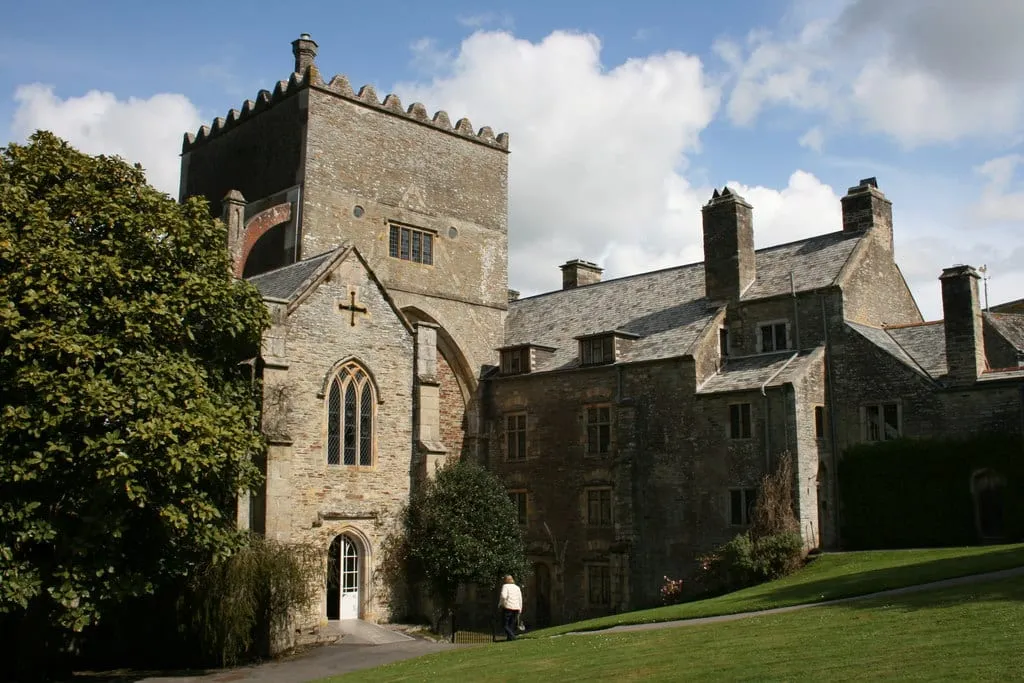
Near Yelverton, in Devon, Buckland Abbey is one of the most emblematic places of the redistribution of monastic property under the Tudors — and of the golden age of English sailors. A former Cistercian abbey become a house, it was the home of Sir Francis Drake, the privateer who sailed around the world and defeated the Armada.
From an abbey to a house
Founded in 1278 by Amicia, Countess of Devon, Buckland was a prosperous Cistercian abbey before being dissolved in 1539 during the great wave of suppression of the monasteries. Henry VIII sold it as early as 1541 to Sir Richard Grenville the Elder, who undertook — like so many buyers of Church holdings — to convert it into a private residence. The work, completed by his grandson Richard Grenville the Younger around 1576-77, achieved a bold transformation: instead of pulling down the church and building elsewhere, the house was lodged within the very body of the abbey church, whose arches and central tower were enclosed in the dwelling — a striking, almost unique case of post-monastic reconversion. The Grenville family also touched the maritime drama of the time: Sir Roger Grenville, father of Richard the Younger, perished in the wreck of the Mary Rose, before the eyes of Henry VIII, in 1545.
The house of Sir Francis Drake
In 1581, Sir Francis Drake — the first Englishman to have sailed around the world (1577-1580), and future hero of the fight against the Armada — bought Buckland Abbey, where he lived for fifteen years and which afterwards stayed in his family. He acquired it discreetly, through intermediaries, without the knowledge of Richard Grenville the Younger: the two men hated each other, and Grenville — himself a great sailor, who would die heroically aboard the Revenge in 1591 facing the Spanish fleet — would never have sold directly to his rival. Buckland still keeps the famous 'Drake's Drum', the great sailor's drum, around which runs a legend: it is said to sound when England is in danger.
A rediscovered treasure
Buckland holds a surprise Drake himself could never have imagined: a self-portrait by Rembrandt, long taken for a mere copy, whose authenticity was confirmed in 2014 after months of laboratory examination. The Dutch painter shows himself wearing a white feathered bonnet. That this masterpiece should have slept, unrecognised, in the former home of the most famous Elizabethan sailor adds an unexpected layer to the memory of the place. Older still, the monumental medieval Great Barn, one of the largest in England, speaks by itself of the agricultural wealth of the Cistercian abbey: its dimensions of a rural cathedral recall that, before the sailors, Buckland fed monks and their flocks.
What to see
- Drake's Drum, the great sailor's legendary drum.
- The great medieval Great Barn, relic of the abbey.
- The tower and arches of the former church, enclosed within the house.
- The great hall beneath the tower, and the Rembrandt self-portrait.
Seeing it differently
Look up inside the house: the tall stone arches that cross the rooms are not decoration but the skeleton of the swallowed church — one lives, literally, inside a nave. Seek the point where the sacred tips into the domestic, where a choir became a parlour. And beneath the barn, measure with your eye the immense roof-frame: it was raised for the tithes and harvests of a convent, long before a privateer's memory was stored there. Buckland thus layers three Englands — that of the monks, that of the sea-adventurers, that of the collectors — within a single casket of stone.
Did you know?
Francis Drake could not buy Buckland openly: its owner, Richard Grenville the Younger, hated him — the two most glorious sailors of Devon were bitter rivals. Drake therefore had to go through intermediaries to acquire the abbey in 1581, without the knowledge of Grenville who, discovering the ruse, never forgave him for it. National glory did not efface the grudges of the parish.
Notes
Buckland Abbey lies at Buckland Monachorum, near Yelverton, in Devon; it is today in the care of the National Trust.
Quiz
- What became of the abbey church of Buckland?
- It was converted into living quarters
- It was razed
- It remained a place of worship
- Which great sailor bought Buckland in 1581?
- Sir Francis Drake
- Walter Raleigh
- Humphrey Gilbert
- How did Drake have to buy it?
- Through intermediaries (the owner hated him)
- At public auction
- As a gift from the queen