
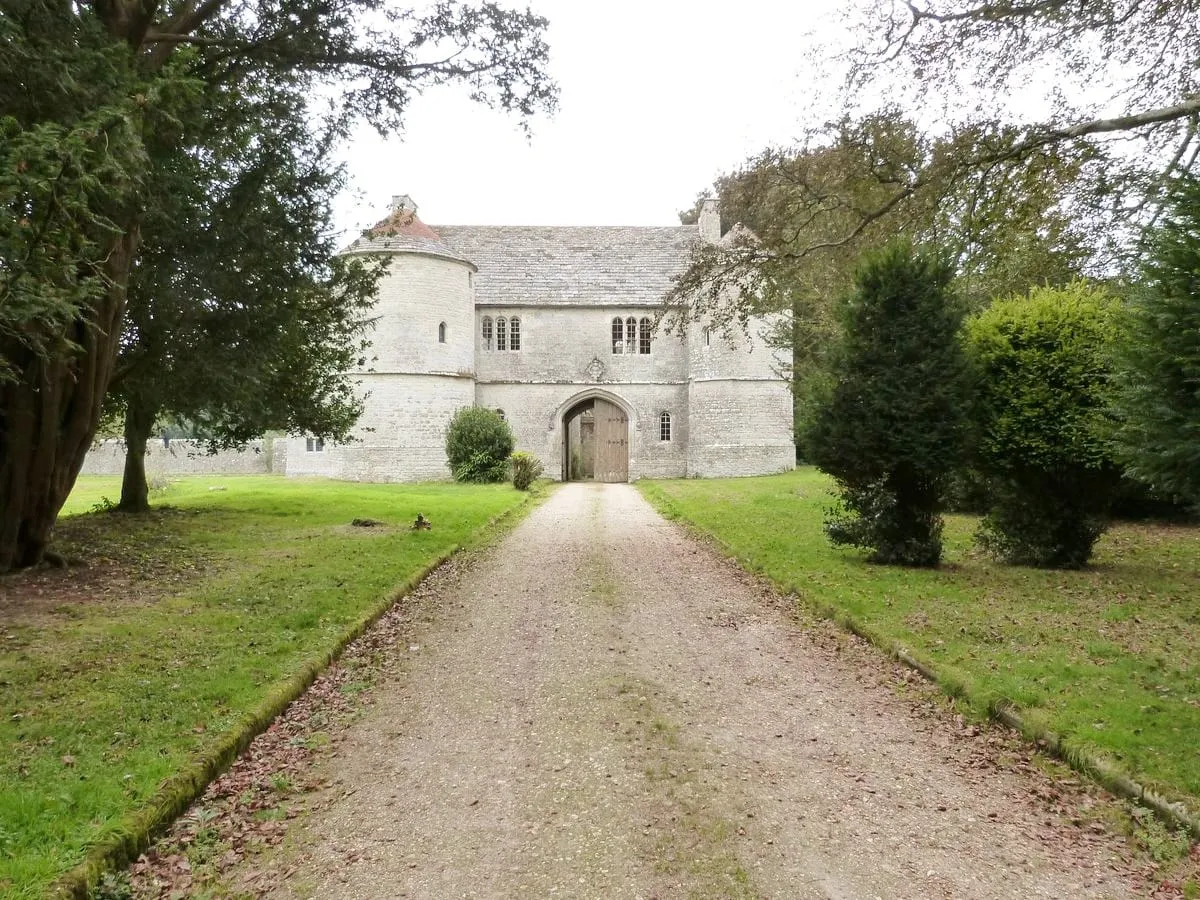
North-west of Dorchester, in Dorset, Wolfeton House is the seat of the Trenchards, one of the great families of the county in the sixteenth century. Its house keeps the memory of an extraordinary episode: the way in which a royal shipwreck, one January day in 1506, changed the destiny of another family and gave birth to a ducal dynasty.
The seat of the Trenchards
Built around a courtyard block raised about 1480, among the water-meadows near the confluence of the rivers Frome and Cerne, Wolfeton was enlarged over the century: its south front, the oldest part, was completed in 1528, its gatehouse in 1534, and its great stone staircase in 1580. The whole illustrates the rise of the Dorset gentry. Its carved Elizabethan and Jacobean panelling, its Great Chamber with its sixteenth-century floor and chimneypiece, its stone staircase whose balustrade is adorned with carved figures, and its gatehouse peopled with figures — a satyr, wood-mice, and even a curious Native American silhouette, a distant echo of the great discoveries — make it a condensed image of the Renaissance imagination. It was Sir George Trenchard, probably to celebrate the knighthood he received from Elizabeth I in 1588, who gave the house its most sumptuous Elizabethan wing: windows with their lavish display of glass, worked plaster ceilings, monumental chimneypieces and moulded oak. In 1610 the Trenchards further raised, within the grounds, a covered riding house for the learned exercise of horsemanship — one of the oldest surviving buildings of its kind in England, a rare witness to the courtly art of the managed horse.
The shipwreck that made the Bedfords
In January 1506, a literal stroke of fortune struck Wolfeton. Archduke Philip of Austria (Philip the Handsome) and his wife Joanna of Castile, sailing towards Spain, saw their ship forced to put in on the Dorset coast by the storm, near Melcombe Regis. Sir Thomas Trenchard received them at Wolfeton — but, not speaking their language, he sent for a young kinsman from west Dorset who mastered Castilian, learned in the wine trade: John Russell. The latter made so good an impression that he was recommended to Henry VII and launched at court. From this chance was born the fortune of the Russell house, future Earls and then Dukes of Bedford, one of the greatest families in England. The Renaissance history of Wolfeton thus rests less on its stones than on that day of storm when the fortune of a new man turned on a gift for languages. To see: the three-storey tower and the octagonal garderobe tower, the stone staircase of 1580 with carved figures, the Great Chamber, the gatehouse with satyr and wood-mice.
Did you know?
All the greatness of the Dukes of Bedford may rest on a storm: in 1506, had Archduke Philip's ship not been cast onto the Dorset coast, young John Russell would not have been called to Wolfeton to serve as interpreter, nor noticed, nor launched at the court of Henry VII. A shipwreck, a gift for languages — and a dynasty was born.
Markers
Wolfeton House lies near Charminster, north-west of Dorchester, in Dorset, among the water-meadows at the confluence of the Frome and the Cerne. The interest of the place is mainly historical and dynastic.
Quiz
- Whom did Sir Thomas Trenchard receive at Wolfeton in 1506?
- Archduke Philip of Austria and Joanna of Castile
- Henry VIII and Anne Boleyn
- The pope
- Which young kinsman served as interpreter there?
- John Russell, future Duke of Bedford
- Thomas Cromwell
- Walter Raleigh
- What did this episode found?
- The fortune of the house of Bedford
- The Virginia Company
- The Anglican Church