
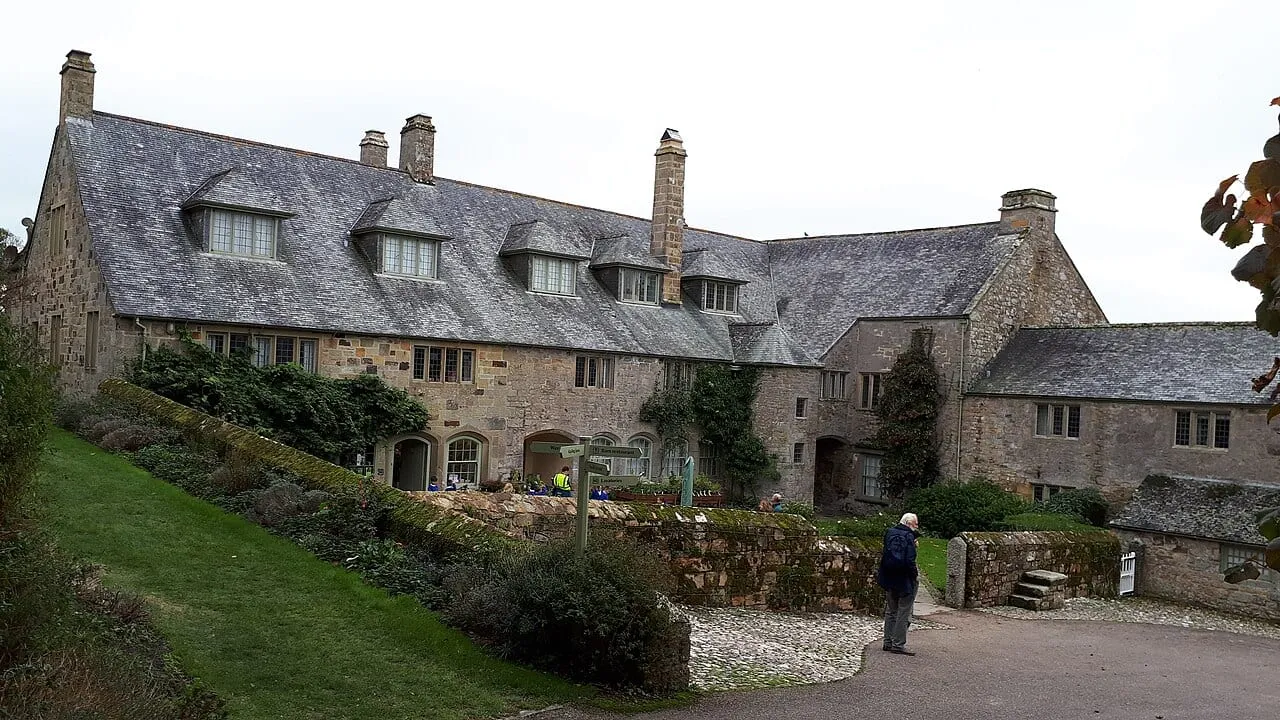
Near Newquay, in Cornwall, Trerice is an Elizabethan manor of rare elegance, rebuilt by the Arundells, one of the great Cornish gentry families. Its front with scrolled gables and its great mullioned window make it a jewel of late-sixteenth-century domestic architecture.
The rebuilding of 1572
The Arundells had owned Trerice since the fourteenth century. But it was around 1572, in the full reign of Elizabeth I, that Sir John Arundell rebuilt the manor in the new taste, giving it its present E-plan form. The date '1572' is carved on the chimneypiece of the great hall, and '1573' on one of the overmantels of the upper floor — the dated signatures of the work. Its most striking singularity lies in its Dutch-style scrolled gables, held to be the earliest of their kind now known in England, preceding those of Kirby Hall and Wollaton Hall: a distant echo of the Low Countries, set upon a Cornish house. The great hall, lit by an immense multi-mullioned window and crowned by a minstrels' gallery, embodies the refinement of the Elizabethan gentry, eager for comfort and display.
The genius of plaster
The hidden treasure of Trerice is its West Country plasterwork, among the finest in the region. The Great Chamber unfolds a barrel ceiling adorned with interlace, garlands and coats of arms in relief, accompanied by a worked and dated chimneypiece. This stucco work, executed by virtuoso local craftsmen, replaced the open timber roofs of the Middle Ages with a sky of white and ordered motifs — a new, Elizabethan way of celebrating light and ornament within the house. It is there, with the eye raised to the ceiling, that the visitor best grasps the ambition of a provincial family determined to hold its rank among the great. Few houses of the age surviving in Cornwall can rival this ceiling for delicacy.
A family of admirals and scholars
The Arundells of Trerice illustrate the many facets of the Tudor gentry. Sir John Arundell 'Jack of Tilbury' (1495-1561) was vice-admiral under Henry VIII and was knighted at the Battle of the Spurs (1513). His descendant John Arundell was High Sheriff of Cornwall. The family also counted, by alliance, the antiquary Richard Carew, son-in-law of the house, author of the Survey of Cornwall (1602) — a pioneering enquiry into the county's history and geography, a precious source on Elizabethan Cornwall.
What to see
- The front with Dutch scrolled gables, the earliest known in England.
- The great hall with its mullioned window and its minstrels' gallery.
- The barrel ceiling and the plasterwork of the Great Chamber, dated 1572-1573.
- The great oak refectory table (about 6 m), too large to leave the hall.
Did you know?
The table of Trerice's great hall — a monolith of oak nearly six metres long — is a prisoner of the room it furnishes: too long to pass through the door, it was assembled on the spot and has never left since. Like so much furniture of the great Tudor houses, it belongs to the house more than to the family: people moved, but the table stayed.
Notes
Trerice lies at Newlyn East, near Newquay, in Cornwall; it is a National Trust property, amid its gardens.
Quiz
- From when does the rebuilding of Trerice date?
- From c. 1572 (date carved on the chimneypiece)
- From 1066
- From the eighteenth century
- Which antiquary, allied to the Arundells, wrote the Survey of Cornwall?
- Richard Carew
- John Stow
- William Camden
- What is particular about the great hall table?
- Too large to remove, it has never left the room
- It is of gold
- It belonged to the king