
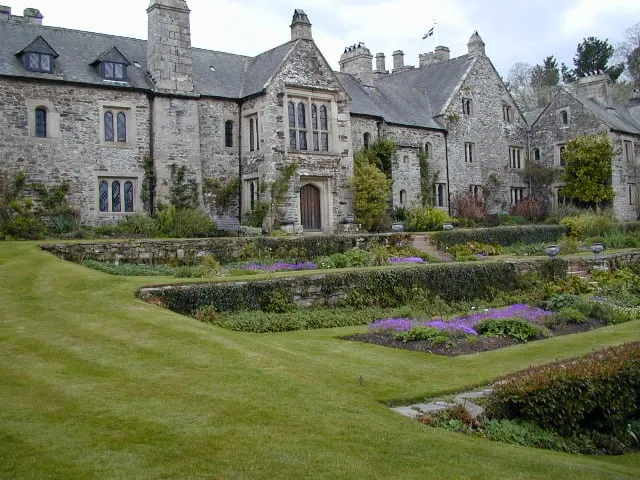
Perched above the Tamar valley, in Cornwall, Cotehele is one of the best-preserved Tudor manors in England. Built by a family rewarded for its loyalty to Henry Tudor, it offers the rare privilege of entering a sixteenth-century interior almost intact — frozen by the family's move.
The reward of a loyal man of Henry VII
Sir Richard Edgcumbe had supported Henry Tudor and fought at his side; after the victory of Bosworth (1485), he was rewarded with offices and honours. A stubborn legend tells how, earlier, hunted by the men of Richard III, he escaped his pursuers by throwing into the Tamar his cap weighted with a stone: believing he had drowned, the soldiers gave up the chase. In thanksgiving he is said to have raised a chapel in the woods above the river. Strengthened by royal favour, he transformed Cotehele into a vast manor arranged around three successive courts, a work carried on by his son Sir Piers Edgcumbe until around 1520. The great hall, with its arch-braced roof (whose timbers were felled around 1500), is its heart: it is the archetype of the great Tudor hall, the place of life and reception of a seigneurial house, where men dined beneath the arms and trophies hung on the walls.
A house preserved by oblivion
Cotehele owes its exceptional preservation to a happy chance. In the mid-sixteenth century (1547-1553), the Edgcumbe family had a new residence built, Mount Edgcumbe, on the coast facing Plymouth: Cotehele thenceforth became a secondary residence, little inhabited and little modified. The manor thus found itself frozen in its Tudor state, preserved by the very indifference of its owners, who later took a pious care to modernise nothing. It keeps a rare set of old Flemish tapestries and 'verdures', hung from wall to wall, a chapel with an altarpiece and an early-sixteenth-century Flemish Crucifixion, and the 'Cotehele clock', reckoned the oldest unaltered domestic clock in England, still in its original place.
What to see
- The arch-braced great hall, bristling with armour and trophies.
- The Cotehele clock, an iron mechanism still in its original place.
- The Flemish tapestries that line the chambers.
- The chapel and its Flemish Crucifixion.
Seeing it differently
What one comes to Cotehele to find is less an object than an atmosphere: the deliberate dimness of the rooms, for no great modern windows were ever cut that would have bleached the colour from the hangings. Watch how the sparing light slides over the old wools and the blackened wood; seek, in the chapel, the bare mechanism of the clock, without dial or hands originally — a machine to strike time, not to show it. Everything here hangs on an absence: that of modernisation. Cotehele is a manor saved by what was never done to it.
Did you know?
Cotehele holds perhaps the oldest domestic clock in England to remain unchanged: an iron mechanism of the fifteenth-sixteenth century, still in its place, without dial or hands originally — it simply struck the hours. That this fragile ancestor of our clocks has survived for centuries owes to the same miracle as the manor itself: the family had forgotten it when they moved.
Notes
Cotehele lies at Calstock, in Cornwall, above the Tamar valley; the house is today in the care of the National Trust.
Quiz
- Why could Sir Richard Edgcumbe enlarge Cotehele?
- Rewarded after Bosworth (1485)
- He won the lottery
- He stole a treasure
- Why is Cotehele so well preserved?
- The family moved to Mount Edgcumbe, freezing Cotehele
- It was restored in the nineteenth century
- It was never inhabited
- What particularly rare thing does Cotehele hold?
- The oldest unaltered domestic clock in England
- The throne of Henry VIII
- An Egyptian mummy