
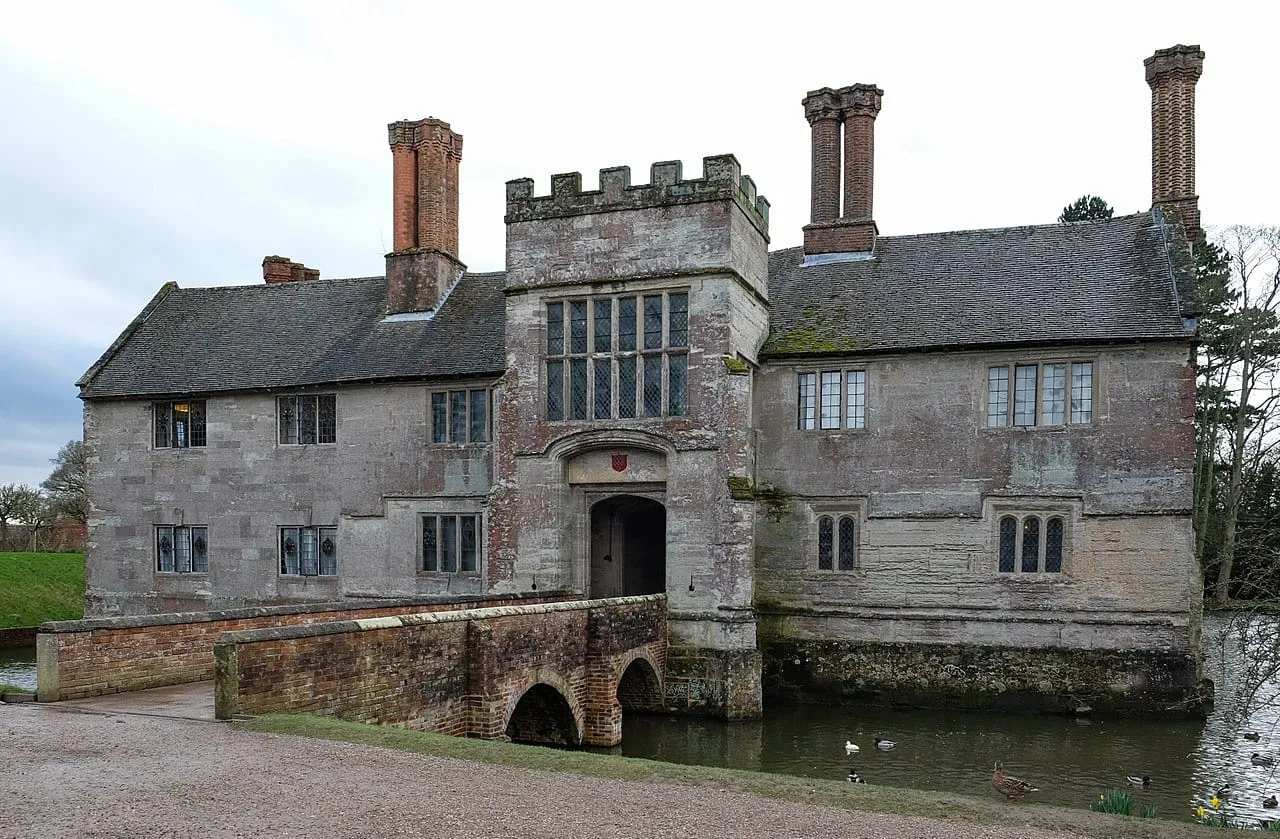
In the heart of the old Forest of Arden, in Warwickshire, Baddesley Clinton seems asleep on its moat, a grey stone manor left almost unchanged since the Middle Ages. Beneath this apparent peace, the house hides one of the most moving stories of persecuted Catholic England.
A manor out of time
A moated manor of the fifteenth and sixteenth centuries, Baddesley Clinton owes its charm to its modesty: never turned into a great house of state, it has kept its medieval face — inner courtyard, great hall, bridge over the moat. The water that rings it is no mere ornament: it set the house apart, protected it, and one October morning in 1591 it would save lives. The house then belonged to the Ferrers family, owners since the late fifteenth century. Henry Ferrers (1549-1633), known as 'the Antiquary' for his passion for history and heraldry, was its master; faithful to the old religion, he leased the house to wealthy Catholic widows, Anne Vaux and her sister Eleanor Brooksby, who made it a refuge for the clandestine priests who roamed England at the risk of their lives. Like other recusant houses, Baddesley was fitted with cunningly hidden priest holes.
The night of the seven priests
The most famous episode took place in October 1591. Several of the great names of the Jesuit mission in England were then gathered in secret at Baddesley Clinton, among them Father Henry Garnet, superior of the Jesuits, and Father John Gerard, who described the scene in his autobiography. At dawn, as the men were preparing to leave, the Crown's agents (the pursuivants) surrounded the house and blocked every approach. The priests — seven, it is said — slipped hastily into a hide fitted into the manor's old drain, crouching ankle-deep in freezing water for more than four hours while the search went on above them. They escaped death: the hunt, noisier than it was skilful, found nothing. The most effective hides of the age, this one among them, were the work of the Jesuit brother Nicholas Owen, a genius of trapdoors and false walls, later captured and tortured to death. Baddesley Clinton keeps the memory of these lives hanging on a wooden panel.
What the eye should seek
The visitor should look up to the chimneys and the panelling, and search the floors and the corners: it is there, in the very thickness of the house, that the hides lie concealed. The great hall, the interiors that have stayed old, the coats of arms dear to Henry Ferrers tell of a family that lived a whole life in the double game of loyalty and forbidden faith. Outside, the reflection of the manor on the black water of the moat prolongs the feeling of a place suspended, out of time and out of danger.
What to see
- The medieval moated manor, inner courtyard and bridge.
- The priest holes, including the one of the night of 1591.
- The great hall and the interiors, with the heraldry of Henry Ferrers.
- The peaceful setting of the old Forest of Arden.
Did you know?
The hides that saved the priests of Baddesley Clinton were doubtless designed by Nicholas Owen, a small man of prodigious skill, who spent years secretly digging, alone and by night, dozens of hides in the Catholic houses of England. Captured in 1606, he was tortured so cruelly in the Tower that he died without giving up a single secret. The Catholic Church has since canonised him: the saint of the hides still watches, invisible, over houses like Baddesley Clinton.
Notes
Baddesley Clinton lies near Warwick, in Warwickshire, in the centre of England. It is today a manor in the care of the National Trust, set amid its gardens and its waters.
Quiz
- What did Baddesley Clinton conceal to protect Catholic priests?
- Priest holes
- An underground passage to the forest
- A secret open-air chapel
- What happened at Baddesley Clinton in 1591?
- Seven priests escaped a search by hiding
- A fire destroyed the manor
- The queen was received there
- Who designed the famous hides of the Catholic houses?
- The Jesuit Nicholas Owen
- Robert Smythson
- Inigo Jones