
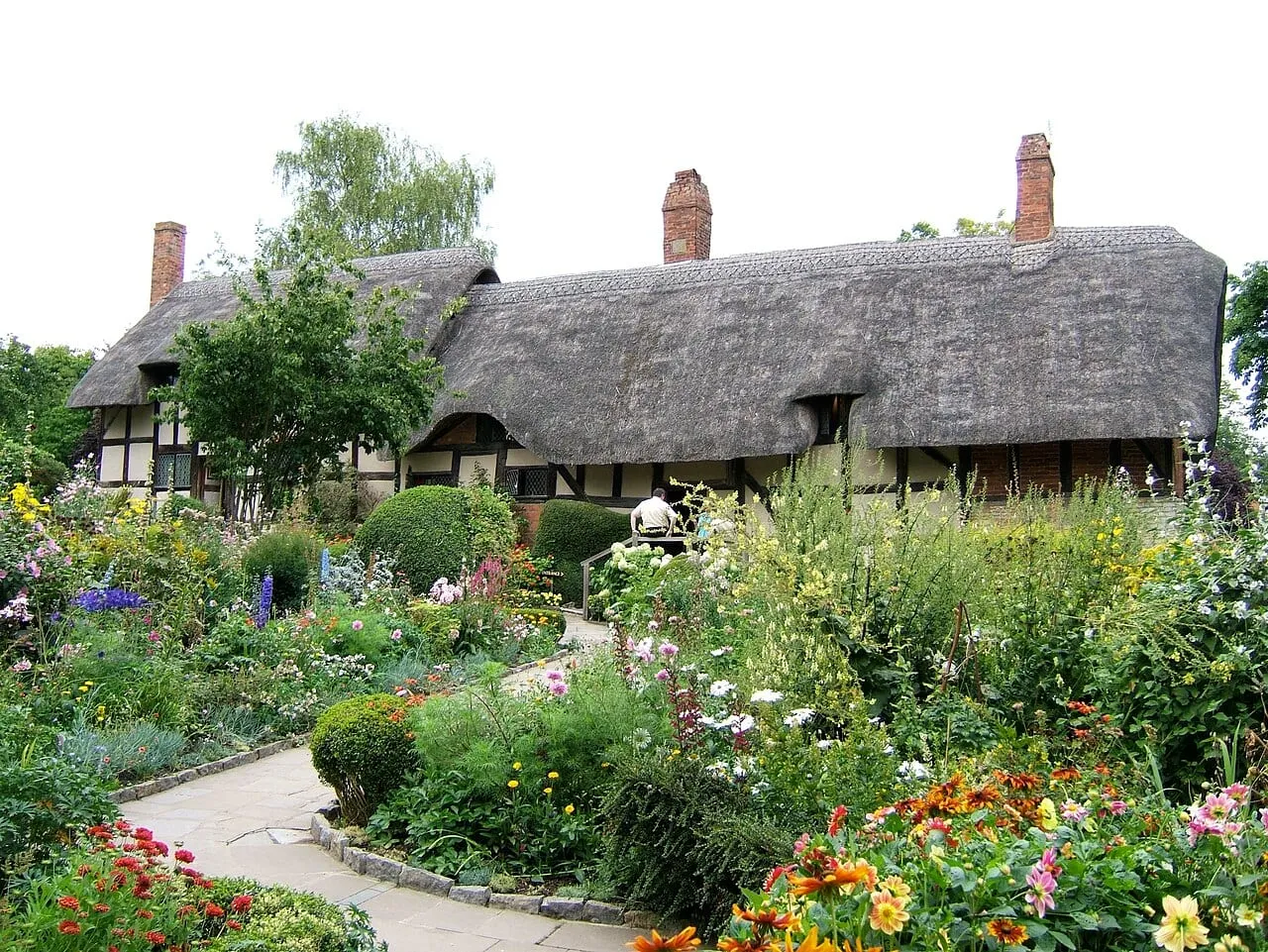
At Shottery, a few minutes from Stratford, this charming timber-framed, thatched farmhouse was the childhood home of Anne Hathaway, Shakespeare's wife. It was here, tradition says, that young William came to court her — and the place today embodies the idyll of the poet's beginnings.
The Hathaways' farm
The oldest part of the house goes back to around 1463; the Hathaway family owned it from 1542. It was in fact a substantial farm — called 'Hewlands Farm', with more than 90 acres of land — and not a mere 'cottage' in the modern sense: the word here means the Tudor vernacular dwelling, timber-framed and daub-filled, the archetype of the English rural house of the Renaissance. In its earliest form the building had only three ground-floor rooms; it grew generation by generation as the family prospered along with its land. Anne grew up there; her father, Richard Hathaway, a well-to-do yeoman, died there in 1581, leaving his eldest son an estate of some one hundred and twenty acres. Her brother Bartholomew (died 1624) inherited the farm and enlarged it in the early seventeenth century; his descendants later added an upper storey, raising the higher part of the house that can still be told apart today from the original walls. The Hathaways held the place for several centuries, until the Shakespeare Birthplace Trust bought it in 1892 to preserve it.
A timber-framed house
Everything at Shottery speaks of the English rural house of the late medieval age: the thick, softly sloping thatched roof, the oak beams, blackened with age, drawing on the white render the famous chequer of the timber frame, the small windows with wooden mullions and diamond panes, the flagstone floors and low ceilings. Inside, look for the broad open-hearth fireplaces (inglenooks) where the household fire once burned, and the oak settles built into the walls. Nothing of a manor house here: this is the home of a family of prosperous husbandmen, and that is precisely its value — an almost intact witness to ordinary life in Shakespeare's day. The thatch, renewed over and over by local craftsmen, and the walls that have never ceased to be lived in, give the place the warmth of a house that time has shaped rather than embalmed.
Shakespeare's idyll
It was to Anne Hathaway that William Shakespeare, eight years her junior, was united in 1582 — she was twenty-six, he eighteen, and she was already pregnant with their daughter Susanna. The Shottery farm is thus the setting of the playwright's youth and courtship, before his departure for London and glory. The place, with its Tudor interiors and its gardens planted with species cited in his work, keeps the memory of this love story at the origins of the greatest of poets. To see: the Tudor interiors and furniture, the timber frame, the gardens (the 'Miss Willmott's garden', 1920) planted with species evoked by Shakespeare.
Did you know?
A piece of furniture in the house is traditionally called the 'courting settle': it was there, local legend says, that young Shakespeare came to court Anne. Nothing proves it, of course — but the Shottery farm has fed, century after century, the romantic imagination attached to the poet's loves, to the point of becoming a place of pilgrimage for lovers.
Markers
Anne Hathaway's Cottage lies at Shottery, in Warwickshire, about 1.5 km west of Stratford-upon-Avon; it has belonged to the Shakespeare Birthplace Trust since 1892.
Quiz
- Who spent their childhood in this farm?
- Anne Hathaway, future wife of Shakespeare
- Queen Elizabeth
- Mary Arden
- In what year did Shakespeare marry Anne?
- In 1582
- In 1616
- In 1500
- What was this 'cottage' really?
- A substantial farm (Hewlands Farm, 90 acres)
- A royal palace
- A mere hut