
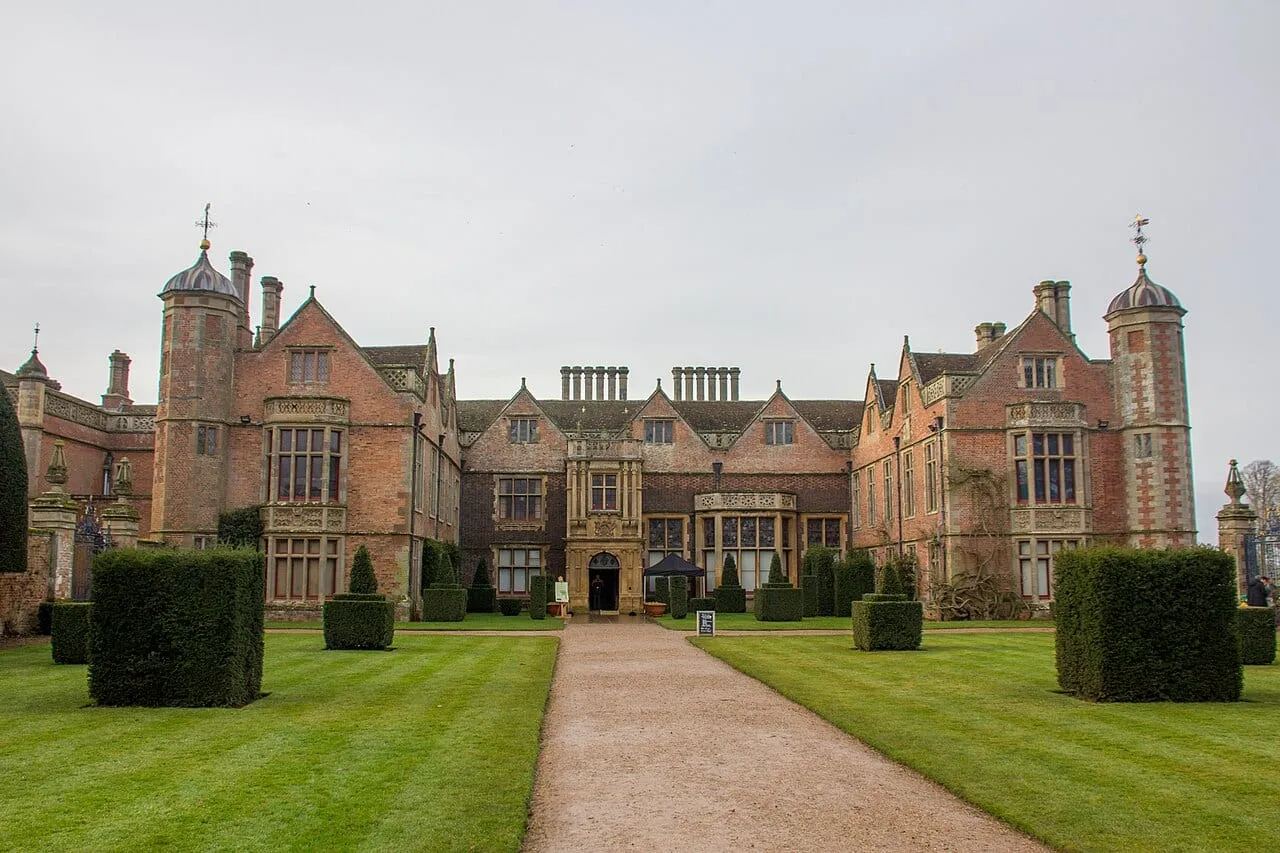
By the Avon, not far from Stratford, Charlecote Park unfurls its long façade of rose-pink brick and its deer park. Built by the Lucy family under Elizabeth I, the house is linked to a famous legend: it was here, it is said, that the young Shakespeare poached deer — and took the road to London to escape.
A house of the Elizabethan gentry
Sir Thomas Lucy, a Warwickshire gentleman and justice of the peace, inherited Charlecote in 1551; married to the heiress Joyce Acton, he had the old medieval manor pulled down and built a large brick house completed around 1558, the very year of Elizabeth I's accession. The house, on an E-shaped plan (a common homage to Queen 'Elizabeth'), opens through an elegant turreted gatehouse, raised about 1565, the year Lucy was knighted. Tradition relates that the queen herself was received here in 1572: in memory of that visit, the two-storey entrance porch was adorned with Elizabeth's royal arms, which can still be made out. Around the house spreads a vast deer park, formally created as early as 1477, where the descendants of the period's herds still graze today: it is this park that made the legend of the place. In the eighteenth century the landscape gardener 'Capability' Brown reshaped the surroundings for George Lucy, widening the course of the Avon and sweeping away the formal gardens in favour of a naturalistic park; but the gatehouse and the Tudor silhouette themselves have remained intact.
The legend of the poacher
According to an old tradition, the young William Shakespeare, born at nearby Stratford, was caught poaching deer in the park of Sir Thomas Lucy. Pursued by the master of the house, he is said to have left Warwickshire for London — and thus to have become, by accident, a dramatist. It is added that he took revenge by caricaturing Lucy as the vain magistrate Shallow in his plays; commentators have even claimed to read, in the 'luces' (pike) of Shallow's coat of arms, a pun on the name of Lucy. Nothing proves this story, born long after the poet's death; but it has made Charlecote a place of Shakespearean pilgrimage, where one likes to imagine the first steps of a genius on the poaching side.
What to see
- The rose-pink brick façade on an E-plan and the turreted gatehouse.
- The porch bearing Elizabeth I's arms, memory of the 1572 visit.
- The great hall and the interiors of the Lucy family.
- The vast deer park by the Avon.
- The memory of the poaching legend of Shakespeare.
Did you know?
The poaching legend is probably a late invention — but it dies hard, for it offers a romantic origin for Shakespeare's genius: a turbulent teenager driven from his village, forced to make for London, and become by that chance the greatest dramatist in the world. Whether the story is true or not, it tells a deeper truth: it was indeed from this corner of Warwickshire, between Stratford and Charlecote, that the local child set out towards the stage.
Markers
Charlecote Park lies near Wellesbourne, in Warwickshire, in the centre of England, not far from Stratford-upon-Avon. It is today a house in the care of the National Trust, with its deer park.
Quiz
- Which legend is attached to Charlecote Park?
- The young Shakespeare is said to have poached deer there
- A Roman treasure is said to be buried there
- Anne Boleyn is said to have been born there
- Which family built Charlecote under Elizabeth I?
- The Lucys
- The Cecils
- The Howards
- What still surrounds the house today?
- A deer park
- A deep moat
- A stone labyrinth