
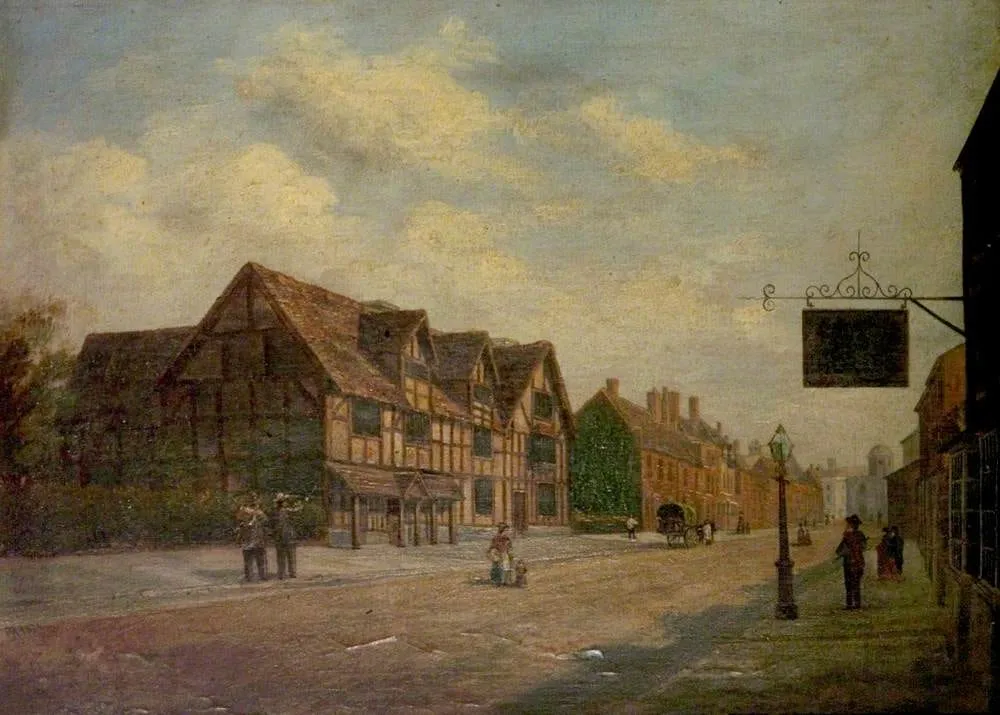
On Henley Street, in the heart of Stratford-upon-Avon, stretches a half-timbered sixteenth-century house that draws pilgrims from across the world. It was here, by well-established tradition, that William Shakespeare was born in 1564 and spent his childhood. Few places on earth carry such symbolic weight: behind a plain front of wood and plaster lies the cradle of the greatest dramatist in the English language, and one of the major shrines of the European literary Renaissance.
The house was originally, however, nothing more than a good craftsman's dwelling. The poet's father, John Shakespeare, was a glover and dealer in skins. Records show him living on Henley Street from the 1550s: in 1552 he was even fined there for leaving a heap of muck outside his door, a slight detail that suddenly anchors the legend in the mud of a Tudor street. At William's birth in April 1564, John was renting the property; ten years later, in 1574, he was able to buy two Henley Street houses freehold. The building was divided: one part served as the family home, the other as the workshop and shop where John worked leather. He is thought to have lived and worked there for some fifty years.
To cross the threshold, then, is to enter a house of the rising Elizabethan middle class — neither palace nor hovel, but the comfortable dwelling of a local worthy, John Shakespeare having held municipal offices in Stratford. The restored interior brings back the flagged floors, the hearths, the oak furniture, the parlour and the workshop: the concrete setting of a sixteenth-century childhood, the atmosphere in which a glover's son learned his letters before becoming the poet who would reinvent the theatre. One imagines the smell of the skins, the noise of the market street, the grammar school close by where, in all likelihood, he received the Latin education that runs through his work.
The house long remained in the Shakespeare family. At the poet's death in 1616 it was lived in by his widowed sister, Joan Hart. It later passed to descendants, served as an inn and as lodgings, before becoming, in the nineteenth century, the object of organised veneration: in 1847 a national subscription secured its purchase for the nation, and it is today owned by the Shakespeare Birthplace Trust, which watches over it as a collective treasure.
The house itself repays attention to its structure. It is a timber-framed building, with exposed oak beams and infill of wattle, daub and plaster, once crowned with thatch before the later roofs — the archetype of English vernacular building of the sixteenth century, that of prosperous market towns. Its division into two parts, dwelling on one side, workshop and shop on the other, faithfully reflects the double life of a well-to-do craftsman's household, where work and family lived under a single roof. Over the centuries the son's fame slowly transformed the house: generations of visitors carved their names there, and soon every beam was venerated as a relic, until the dwelling became a true national monument.
In our atlas, Shakespeare's Birthplace holds a place apart. It is no castle, nor a great seigneurial seat: it is a civil building, a town house, and that is precisely its value. It reminds us that the English Renaissance was not played out only in palaces and courts, but also in the market towns of the provinces, where a cultivated middle class watched its children grow up between workshop and school. From this modest, hardworking milieu arose the most universal body of work in English literature. To stand in these low rooms is to touch the fertile paradox: genius was born not of a palace, but of a glover's house on a Stratford street.